I pulled the UK search data before writing this, and it says something uncomfortable about how small business owners think about reviews.
“How to remove google reviews” gets around 720 searches a month in the UK. Add the near identical variants, “can you delete google reviews”, “how to take down a google review”, and a dozen others, and the total runs well into the thousands.
“Do google reviews help SEO” gets 210.
So business owners are several times more interested in deleting one bad review than in understanding the system that decides whether anyone finds them in the first place. That is an understandable instinct. It is also the wrong question, and answering the right one is worth considerably more than removing a single one star.
The Short Version
- Review signals are worth roughly a fifth of what decides local pack rankings, second only to your Google Business Profile itself.
- Recency beats volume. A steady trickle of recent reviews outperforms a large pile of old ones, and the gap is widening.
- A perfect five star average can cost you customers, because people read unbroken perfection as manipulation rather than excellence.
- Google changed its review rules in April 2026. Several tactics still being recommended online are now policy violations.
- Buying reviews has been illegal in the UK since April 2025, not merely against Google’s rules, with penalties of up to £300,000 or 10 per cent of global turnover.
- Reviews will not rescue a slow or badly built website. They earn the click. The site decides what happens next.
Yes, Reviews Affect Your Rankings. Here Is Roughly How Much.
Google does not publish the weightings in its local algorithm, so anyone giving you a precise number is estimating. The closest thing to a reliable answer is Whitespark’s annual Local Search Ranking Factors survey, which asks around 47 experienced local search practitioners to weigh up how much each category contributes. The 2026 edition covered 187 individual factors.
Their consensus puts review signals at roughly 20 per cent of what decides local pack and Maps rankings. Only Google Business Profile signals score higher, at around 32 per cent.
Two things are worth pulling out of that.
The first is that reviews are the second largest category, and unlike proximity, which you cannot influence at all, reviews are almost entirely within your reach. You cannot move your business closer to the person searching. You can absolutely change what your review profile looks like over the next six months.
The second is the direction of travel. Review signals accounted for around 16 per cent in the 2023 survey and roughly 20 per cent now. Whichever way Google is tuning its local algorithm, reviews are becoming more important rather than less.
Treat these numbers as informed estimation rather than fact. They come from practitioners who test this for a living, not from Google, and they are the best available evidence rather than the final word. If you want the wider picture of how the rest of it fits together, that is what local SEO covers.
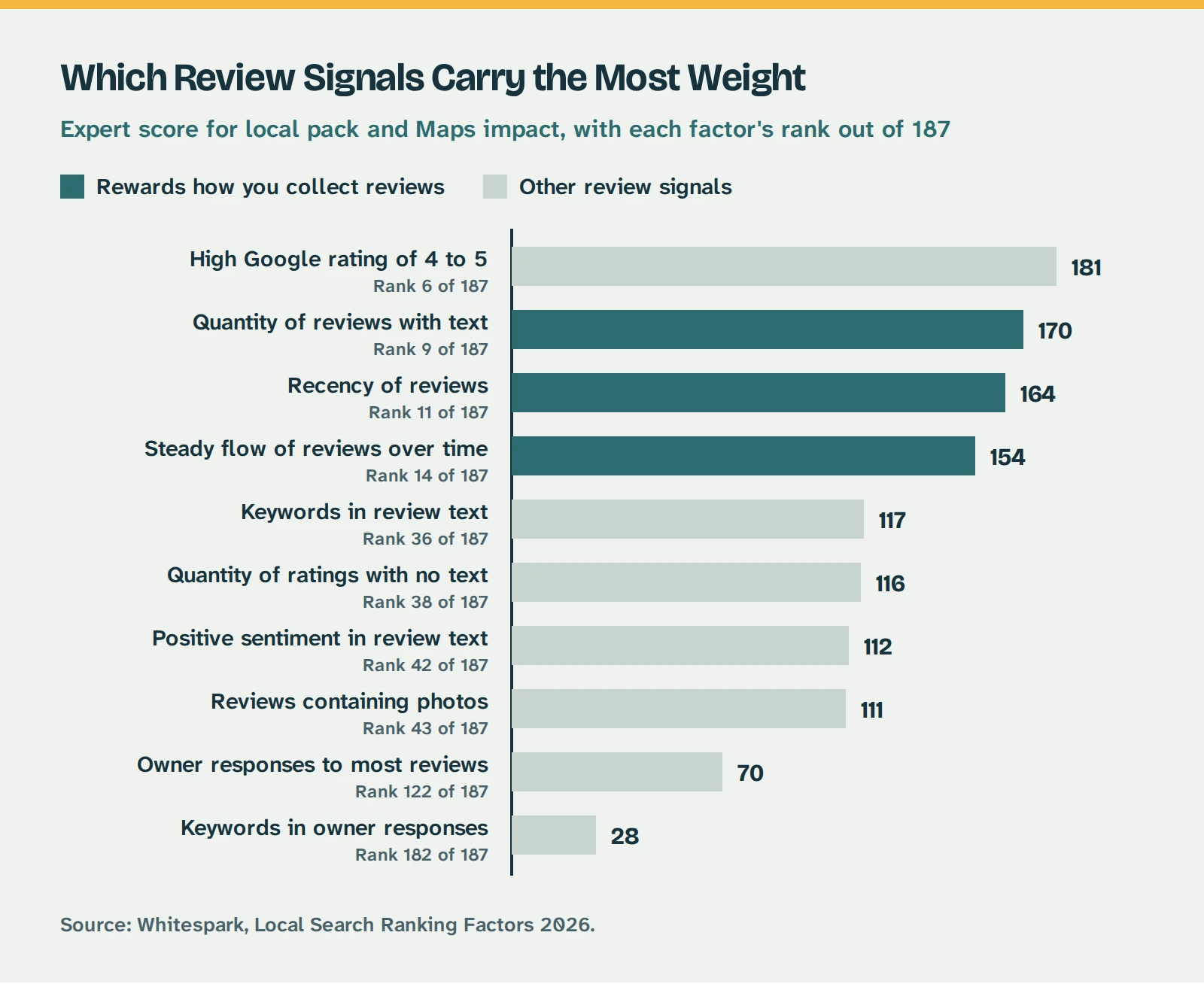
Four review factors sit inside the top 15 of 187. Reviews carrying text score well above ratings with none. Source: Whitespark, Local Search Ranking Factors 2026.
Three Things That Matter More Than Your Review Count
Most advice on this subject reduces to “get more reviews”. That is not wrong, but it is the least useful version of the truth, because it implies the number itself is the prize. It is not.
Recency
This is the one most businesses get wrong. Whitespark’s contributors rank the recency of reviews as the eleventh most important factor out of 187 for local pack and Maps results, and a sustained flow of reviews over time rather than in bursts at fourteenth. Sterling Sky has documented what that looks like in practice.
A client of theirs had quietly stopped encouraging customers to leave reviews. The reviews flatlined. Their visibility degraded, gradually enough that nobody connected the two. When they restarted the habit and fresh reviews began arriving again, their rank tracking grid went from largely red to almost entirely green over the following months.
Nothing else about the business changed. The reviews did not get better. They got newer.
Reviews With Text
A bare five star rating with no words attached is worth less than a review describing what actually happened, and the gap is wider than most people assume. Whitespark’s contributors rank the quantity of reviews carrying text as the ninth most important factor of 187. The quantity of ratings with no text sits at thirty eighth. Those are two things most business owners treat as identical, and they are not. It makes sense if you think about what Google is trying to work out. A star is a number. A sentence is evidence.
The same is true of the humans reading them, who skim past the wall of unexplained five stars and go looking for the ones that describe a real job.
Velocity
Sterling Sky’s testing identified what they call the “magic 10”. Reaching around ten reviews triggers a noticeable ranking improvement, after which the returns diminish quickly. Going from two reviews to twelve will do considerably more for you than going from ninety to a hundred.
What continues to matter beyond that threshold is the rate. Consistent monthly reviews outperform a large but stagnant total, because a steady flow tells Google the business is still operating and still serving people. A pile of old five stars is a trophy. A steady stream of recent ones is a ranking signal.
Put those three together and the practical conclusion is unexpected. A newer business collecting a handful of detailed reviews every month can out rank an established competitor sitting on two hundred reviews that all arrived in 2021.
Why a Perfect Five Star Rating Is Working Against You
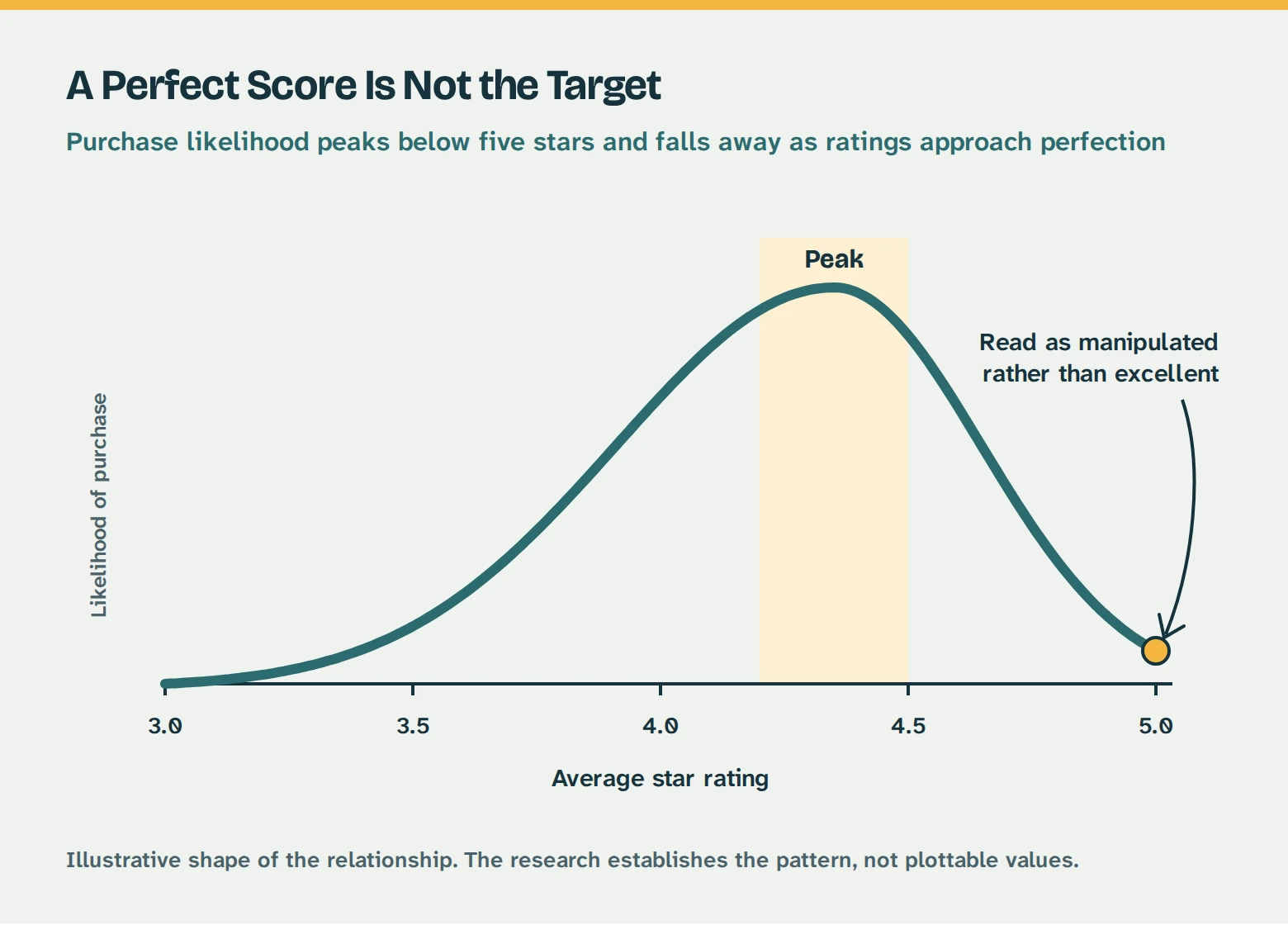
Northwestern University’s Spiegel Research Center analysed ratings data across a large number of product categories and found something that surprises most business owners. Purchase likelihood does not peak at 5.0. It peaks somewhere in the low to mid fours, and then falls away as ratings approach perfection.
The explanation is straightforward. Shoppers know that nothing is flawless. A wall of unbroken five stars does not read as excellence, it reads as curation, and the reasonable conclusion is that somebody has been managing what gets published.
A fair caveat, and one you will not find in most articles citing this research. Spiegel’s work was done on retail products, not local service businesses. Whether a plumber behaves exactly like a set of consumer packaged goods is not something that study proves. Treat it as directional rather than gospel.
That said, the mechanism is about human scepticism rather than product category, and consumer survey data points the same way. It also matches what you probably do yourself. When you look at a tradesperson with 34 reviews and a 4.7 average, you believe it. When you see one with 34 reviews and a straight 5.0, some part of you starts checking the dates.
The practical takeaway is not to go collecting bad reviews. It is to stop treating the occasional four star as a wound. It is doing useful work for you.
Purchase likelihood peaks below a perfect score and falls away as ratings approach five stars. Source: Northwestern University, Medill Spiegel Research Center.
It is also worth remembering that your reviews live on Google, but the decision usually gets made on your website. Someone who has read your Google profile still lands on your site before they ring you, which is why it is worth showing what your customers actually say there too, rather than assuming they will go looking.
What a Bad Review Actually Costs You, and What It Does Not
A single negative review sitting among twenty positive ones is not damage. It is the thing that makes the other twenty believable.
A pattern of negative reviews all saying the same thing is a different matter, but it is still not primarily a marketing problem. If four people in six months have mentioned that you did not turn up when you said you would, no amount of review management is the answer. That is information, delivered free, by people who were annoyed enough to write it down but not annoyed enough to stay silent.
The genuine cost is not the bad review. It is the bad review nobody replied to.
BrightLocal’s 2026 consumer research found that slow or generic responses are increasingly read as a red flag in their own right, and that the speed of an owner’s reply now influences trust alongside the rating itself. An unanswered complaint is a permanent unanswered accusation. A reply that reads like it came from a template is arguably worse, because it demonstrates you have a process for appearing to care.
One caveat on that research, since almost nobody quoting it mentions this: BrightLocal’s survey panel is made up of around a thousand consumers in the United States. The behaviour it describes is not specific to the UK market. It is still the best annual dataset available on this subject, but it is worth knowing what you are reading.
What To Do About a Bad Review
Respond Properly
The useful reply is short, specific and not defensive. Acknowledge what happened, avoid arguing the detail in public, and move the conversation somewhere private. You are not really writing to the person who left it. You are writing to the next forty people who will read it while deciding whether to ring you.
What not to do is easier to list.
- Do not dispute the facts line by line. A long rebuttal makes the complaint look substantial, whether it is or not.
- Do not imply the customer is lying, even when you are confident they are.
- Do not paste the same sentence under every review. Identical replies are easy to spot and read worse than saying nothing.
- Do not offer anything in exchange for a review being changed or removed. That breaches Google’s rules and, in the UK, may breach consumer law.
Can You Get It Removed?
Sometimes, and less often than the industry selling removal services implies.
Google will remove a review that breaks a specific policy. That includes reviews left by competitors or anyone else with a conflict of interest, reviews about a different business entirely, content that is off topic, spam, or abusive. Those are winnable, and reporting them through your Google Business Profile is free.
Google will not remove a review because it is unfair, because you remember the job differently, or because it is costing you money. There is no appeal on the grounds of being annoyed, and no agency has a back channel that changes this. If a service promises guaranteed removal of a genuine negative review, be very clear about what you are actually paying for, because it is not a mechanism Google offers.
The honest strategic answer is that burying is more reliable than removing. A steady flow of recent reviews pushes an old complaint down the page and dilutes its effect on your average far more dependably than any removal request.
The Rules Changed in April 2026, and Most Advice Online Has Not Caught Up
Google updated its Prohibited and Restricted Content policy in April 2026, closing loopholes that a great deal of published advice still recommends. If you set up a review process at any point in the last few years, there is a reasonable chance part of it is now a violation.
| Still Allowed | Now Prohibited |
|---|
| Asking every customer for a review | Screening customers by sentiment first, then sending the link only to the happy ones |
| Making it easy with a direct link or QR code | Offering a discount, gift, prize entry or loyalty points in exchange for a review |
| Asking once, in person or by follow up message | Pressuring customers to leave a review on the spot, including review kiosks and shared tablets |
| Responding to every review, positive or negative | Setting staff a target number of reviews to collect |
| Displaying your reviews on your own website | Asking customers to mention a particular staff member by name |
| A customer naming a staff member unprompted | Reviews from employees, family members, suppliers or anyone with a conflict of interest |
Two of those deserve particular attention.
Review gating is the most common violation and the least understood. If you send customers a survey asking how their experience was, then direct the satisfied ones to Google and the unsatisfied ones to a private feedback form, that is gating. It has been prohibited since 2018 and it is now actively enforced. A number of review collection tools still offer it as a feature.
The staff name clause is new and frequently misread. Google has not banned reviews that mention employees. A customer who writes that Dave was excellent is entirely fine, and that review can stay. What is banned is you asking them to do it.
Enforcement is largely automated, and outcomes range from reviews being quietly removed to profile restrictions and suspension. Losing a profile you have spent three years building is a considerably worse outcome than a two star review.
Buying Reviews Is Not Just Against the Rules. It Is Illegal.
This is the part that most articles on this subject, almost all of them written for a United States audience, do not cover at all.
Since 6 April 2025, the Digital Markets, Competition and Consumers Act 2024 has made fake reviews and concealed incentivised reviews a banned practice in the UK. Not discouraged. Banned, and placed on a list of practices considered inherently unfair.
That listing matters more than it sounds. It means the Competition and Markets Authority does not have to demonstrate that any consumer was actually misled. The conduct alone is the breach.
The CMA can now impose penalties directly, without going through the courts, of up to £300,000 or 10 per cent of global turnover, whichever is higher. Individuals involved can face personal liability, including director disqualification in serious cases. The prohibition covers commissioning reviews as well as writing them, so paying an agency to arrange it puts no distance between you and the breach. It also extends beyond individual reviews to what the legislation calls consumer review information, which includes your aggregate score and review count.
This is not sitting on a shelf unenforced. After a three month grace period ended in July 2025, the CMA reviewed the websites of more than 100 businesses and found that over half could be failing to comply.
Incentivised reviews occupy a slightly different position in law. They are not banned outright, but the incentive must be clearly disclosed. In practice this is academic for Google reviews, because Google prohibits incentives regardless of whether you disclose them. The stricter rule is the one that applies.
If you have ever been approached by somebody offering to sell you Google reviews, and if you run a local business you almost certainly have, that is the risk you would be accepting on their behalf.
Reviews Will Not Fix a Broken Website
Reviews are one input among many, and they cannot compensate for everything else being wrong. Sterling Sky has documented businesses with genuinely impressive review profiles that still ranked badly, because the rest of the picture was not there.
The version of this I see most often is simpler. A business does the review work properly, the profile starts performing, people click through, and then land on a site that takes eight seconds to load on a phone. The reviews did their job. Everything after that threw the result away. That is a website speed problem, not a reviews problem, and no amount of five stars will paper over it.
Where it does work is when both sides are handled together.
I have worked with Liam at LRM UPVC on exactly this combination. When I started, his Google Business Profile had one or two reviews on it, which is below the point where reviews do anything for you at all. Over the following three years he has collected more than 190, consistently, month after month rather than in a single burst.
That distinction matters more than the total. The first twenty or so did most of the commercial work, because that is roughly where a profile stops looking like an unknown quantity. The other 170 are not really the achievement in themselves. What they represent is three years of unbroken recency, which is the single factor that has climbed hardest in importance across that same period. A business that collected 190 reviews in one month would look like manipulation. A business that collected them steadily over three years looks exactly like what it is.
The method is worth spelling out, because it is unremarkable. Liam asks. At the end of a job, while he is still with the customer and the finished work is in front of them, he asks them to leave a review. There is no software, no automated follow up sequence and no incentive. That is the entire system.
Two details are doing the work. He asks at the point of completion, which is when people feel most positive about the job and can still remember the specifics worth writing about. And he asks everybody, rather than making a private judgement about who is likely to say something nice, which is precisely the line between collecting reviews and gating them.
It is also still permitted, which is not true of every method currently being recommended online. Google allows you to ask. What it prohibits is pressuring somebody into doing it on the spot, which is where review kiosks and shared tablets fall foul of the April 2026 rules. Asking a customer to leave a review later is fine. Handing them your phone and waiting is not.
I have also made business cards with a QR code that goes straight to the review page, so customers can do it in their own time. A card somebody puts in their pocket is a long way from a tablet on a counter, and making it easy is explicitly allowed. The friction worth removing is the customer having to hunt for your profile. Not the customer having a choice. If you want to do the same, my free Google review link generator creates your direct review link and a QR code in a few seconds.
Alongside all of that, I worked on the site itself. Both moved together, and both his website and his Google Business Profile now rank better for local searches than they did, which has translated into more work coming in.
Neither half would have achieved the same on its own. A well built site with an empty Google profile does not get shown in the map pack. A strong review profile pointing at a poor website collects clicks and wastes them.
I manage SEO for a global ecommerce agency during the week and run this business alongside it, which means I see this problem at both ends of the scale. The tactics differ enormously. The underlying principle does not. Reviews earn attention. What you do with that attention is a separate job, and it is usually the one being neglected.
Not Showing Up Locally?
Reviews are one part of it. Your Google Business Profile, the pages behind it and whether your site is worth landing on are the rest. Working out which part is holding you back is usually straightforward, and it is worth knowing before you spend anything. Everything I charge is published in full, with no discovery call required to find out.
Local SEO Services