Before I wrote this, I looked up how many people in the UK search for help with a quiet business before it goes quiet.
The answer is roughly nobody.
“Marketing when business is slow” returns no measurable search volume. Neither does “when to start marketing”. Neither does “why is my business so quiet”. “Why is my business not getting customers” comes back at zero.
The searches that do exist are the ones people make afterwards. “How to get more customers” gets around 90 a month. “How to get more enquiries” gets about the same. “How to get more work as a tradesman” gets 30. Those are not planning searches. Those are the searches you make on a Tuesday morning when next month’s diary has three jobs in it, and one of them is a quote you already know you are not going to win.
I do search for a living, so I find this more interesting than ironic. Demand for marketing advice appears at precisely the point where marketing advice is least able to help.
This post covers both halves of the problem. First, how to get more enquiries out of the traffic you already have, because some of that genuinely is quick. Then the honest version of how long the other half takes, which is the actual argument for starting now.
The Short Version
- There are two different problems hiding behind the same complaint. People are not finding you, or they are finding you and not getting in touch. The fixes are not interchangeable.
- Check before you change anything. Google Search Console will tell you which one you have in about five minutes, and it is free.
- If it is a conversion problem, most of it is an afternoon’s work. Phone number, shorter form, an honest answer to the price question.
- If it is a visibility problem, Google’s own documentation says four months to a year before you see the benefit. There is no version of this that takes three weeks.
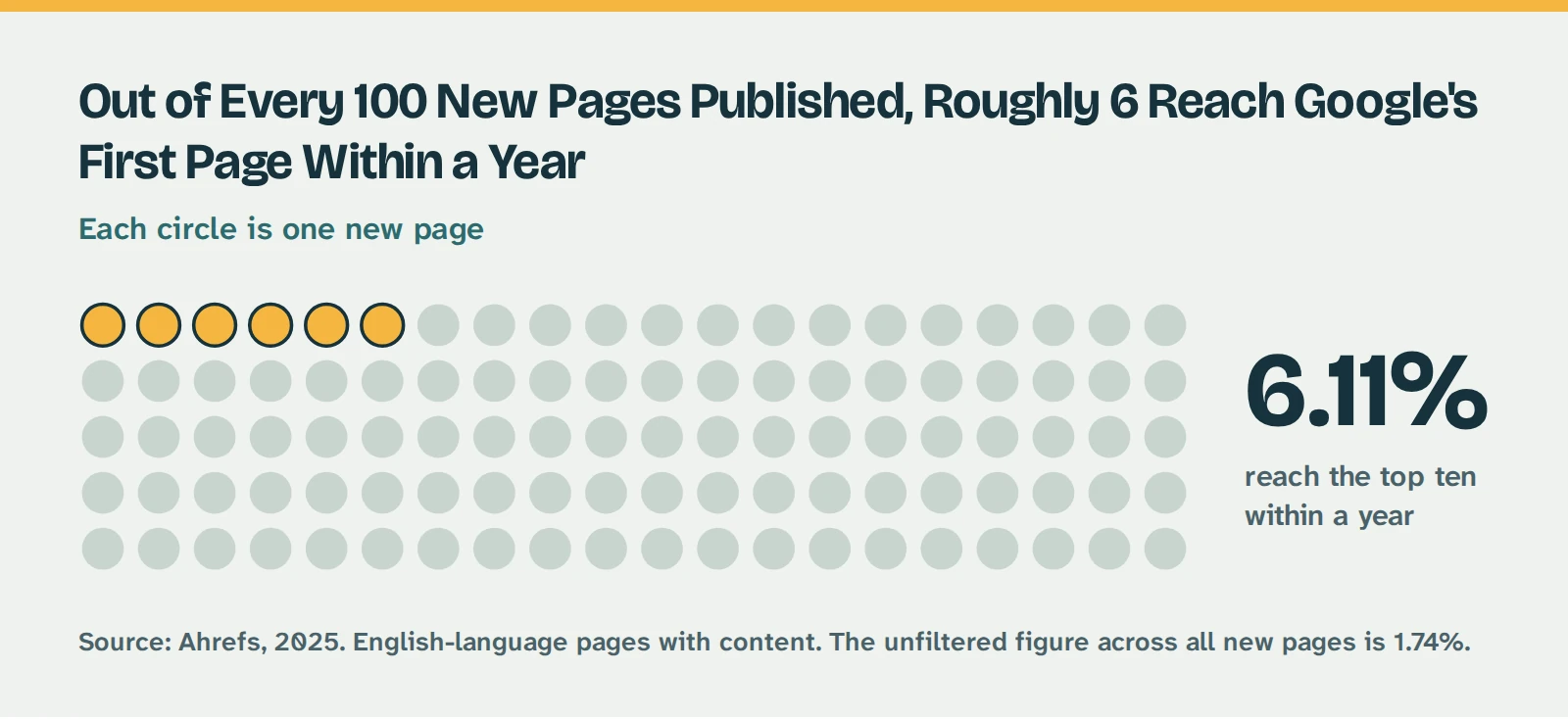
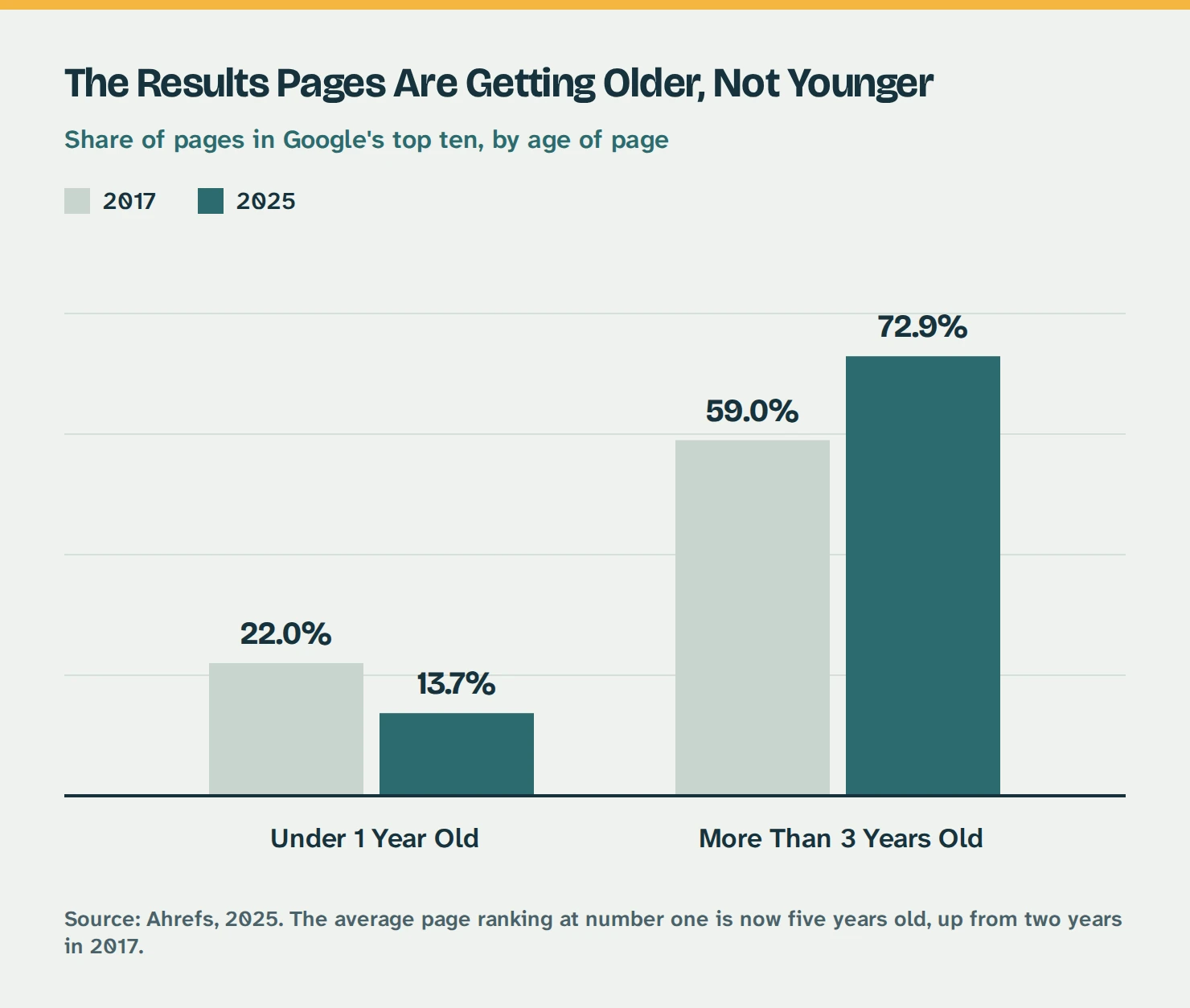
- Roughly six in every hundred new pages reach the first page of Google within a year, and almost 73 per cent of the pages already sitting there are over three years old.
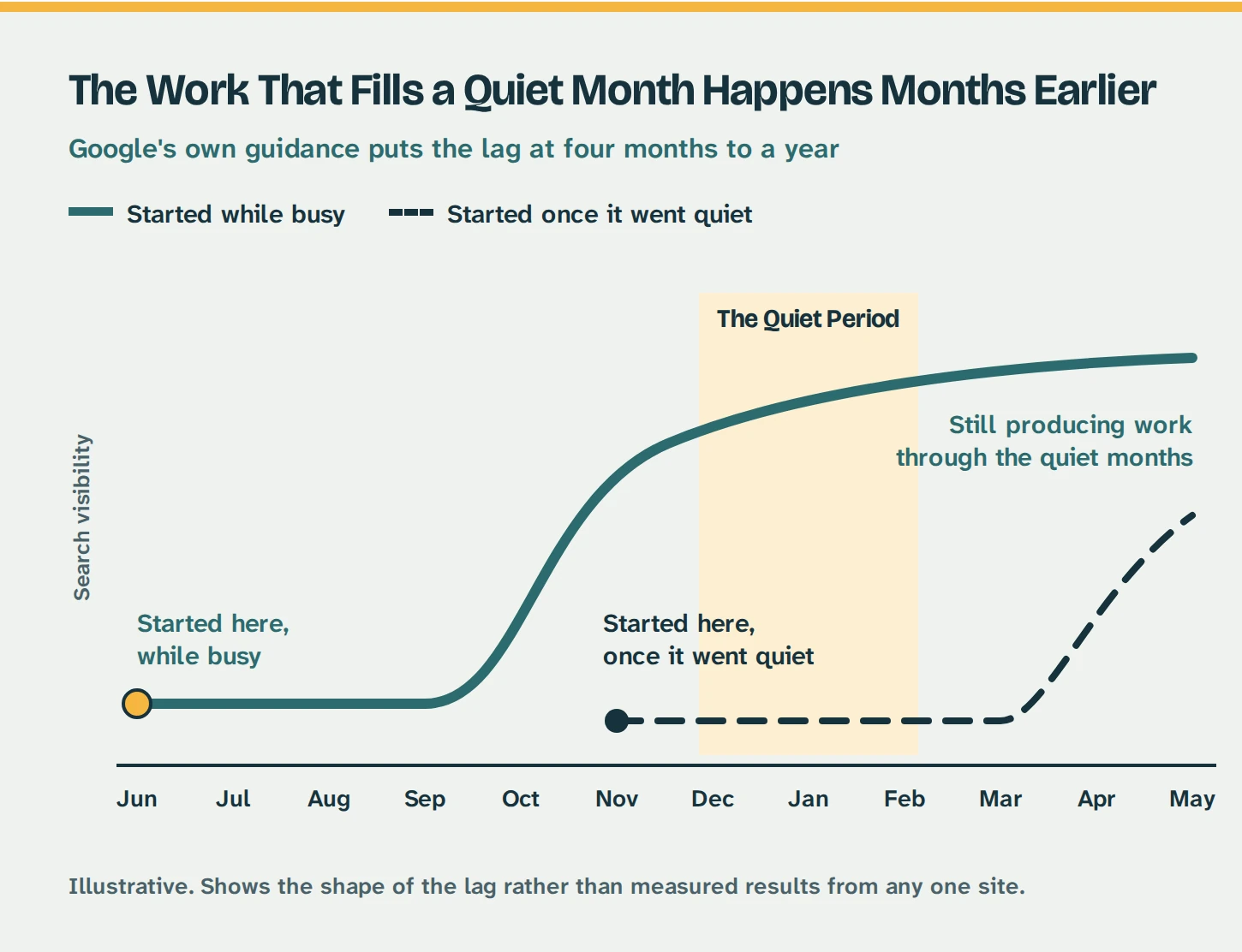
- Which is the whole argument. The work that fills a quiet month happens months earlier, while the phone is still ringing and you are least inclined to think about it.
There Are Two Different Problems Here, and Most Advice Only Solves One
Almost every article on this subject answers one question: how do you turn more of your website visitors into enquiries. That is a real problem with real fixes, and I will come to them.
But it quietly assumes you have visitors.
There are two separate problems hiding under the same complaint. People find your website and do not contact you, which is a conversion problem. Or people do not find your website at all, which is a visibility problem.
The advice for one does almost nothing for the other. If forty people a month land on your site and none of them ring, moving your phone number will help. If four people a month land on your site, you could rebuild the entire thing from scratch and finish the month with the same nothing.
How to Tell Which One You Have
Open Google Search Console. It is free, and if you do not have it set up, that on its own tells you something. Look at the Performance report for the last three months and find your total clicks. If you have Google Analytics, look at monthly users alongside it.
| What You Are Seeing | What It Probably Is | Where to Start |
|---|
| Under about 50 visits a month | Visibility | Google Business Profile, reviews, a page for each service you want more of. No amount of tidying the contact form will change the arithmetic. |
| Over about 200 visits a month, fewer than two or three enquiries | Conversion | Phone number, contact form, the price question. This is the cheapest work available to you and the fastest to show. |
| Somewhere in between | Probably both | Do the conversion half first. It is quicker, and it means the visibility work is not wasted when it eventually lands. |
A locksmith and a wedding photographer need completely different numbers to make a living, so treat those figures as a starting point rather than a target.
If People Are Visiting and Not Getting in Touch
The fixes here are quick, and most of them are free.
Put your phone number where a thumb can reach it. In the header, on every page, set up to dial when tapped. Not buried on a contact page two clicks away. A surprising number of small business websites make you hunt for the one piece of information the visitor came for.
Ask for less. Every field on a contact form is another reason to give up. Name, one way of contacting them, and what they need. That is enough. Asking for a postcode, a budget bracket and a preferred contact window before anyone has spoken to you is a good way to collect fewer enquiries from better-organised people.
Answer the price question. This is the one most businesses dodge, and it costs them more than they realise. People do not enquire when they suspect the answer might embarrass them. A range, a starting price, or even an honest explanation of what moves the number will get you more enquiries than “contact us for a quote”, and the enquiries you do get will be from people who are not about to fall over when you tell them.
Put reviews where the decision happens. Not on a testimonials page that nobody visits. On the service page, next to the thing the review is about. If you want the longer version of why reviews matter beyond the reassurance, I have written about whether Google reviews help SEO.
What Does Not Work, Honestly
While researching this I read a fair amount of the advice currently ranking for these terms, and some of it is worth arguing with.
- Fake activity notifications. Those small popups announcing that somebody in Chester just booked a consultation. On a large national site, perhaps. On a locksmith’s website in Wallasey, where the visitor might actually know the somebody in question, it reads as exactly what it is.
- Live chat on a one-person business. If you are up a ladder, nobody is answering the chat. An unanswered chat widget is worse than no chat widget, because it looks like being ignored rather than being closed.
- Exit intent popups. The visitor has already decided to leave. Interrupting them on the way out changes that almost never, and it is a poor final impression to leave with someone who might have come back.
None of this matters much anyway if visibility is the real problem. Which brings me to the difficult part.
If Almost Nobody Is Finding You, Here Is the Honest Timeline
Google publishes documentation on whether you need an SEO, and it is unusually direct about timescales. The figure it gives is four months to a year from the point you start making changes until you begin to see the benefit.
That is Google’s own number, sitting in its own documentation, not an agency’s disclaimer.
The independent data is harder still. Ahrefs ran a study in 2025 tracking a million pages first seen by their crawler, and found that only 1.74 per cent of newly published pages reach the top ten within a year, down from 5.7 per cent when they ran the same study in 2017.
In fairness, that headline figure includes a great deal of rubbish. Filtered down to English-language pages with actual content on them, the number rises to 6.11 per cent, which is the fairer version and the one I would rather quote. It still means that roughly ninety-four pages out of every hundred do not reach page one inside their first year.
Of every hundred new pages published, roughly six reach the first page of Google inside a year. Source: Ahrefs, 2025.
The results pages themselves have also aged. Almost 73 per cent of pages in Google’s top ten are more than three years old, up from 59 per cent in 2017, and the average page sitting at number one is now five years old, compared with two years in the original study.
The pages you are competing against have been sitting there for years. Source: Ahrefs, 2025.
There is an encouraging half to this, and it matters. Of the pages that did make the top ten, just over 40 per cent got there within a month, and low-volume keywords rank faster than high-volume ones. The route in is narrow and specific rather than broad and ambitious. “Emergency locksmith Wallasey” is a winnable position. “Locksmith” is not, and chasing it is how people spend a year getting nowhere.
So the honest summary is this. Being found is achievable for a small local business. It is not achievable in three weeks, and anybody promising otherwise is either selling advertising or not being straight with you.
Which Is Why You Start While the Phone Is Still Ringing
Everyone in trades and local services already knows their own rhythm. Roofers know what autumn does. Landscapers know what happens in March. Locksmiths know that dark evenings and slammed doors go together. The seasonality is not a surprise to anyone in the business, which is why I build websites for tradesmen around it rather than against it.
And yet marketing spend almost always follows the work rather than leading it. Money goes out when money is coming in, and it stops when things get tight. That feels responsible. It is also precisely backwards, because of the lag.
The lag is the whole argument. What you start in June is what carries you through December.
If it takes four months to a year for search visibility to build, then the work you do in June is what fills September. The work you do in November is what fills the following spring. Starting when the diary empties means you are asking a four-month process to solve a four-week problem, and it cannot.
There is a second trap underneath the first, and it is the one I see most often. When you are quiet, you have the least money and the most urgency at the same time. That is the worst possible state in which to make a buying decision, and it is exactly the state in which people spend two thousand pounds on a rescue package sold by somebody who rang them at the right moment.
The person offering you the emergency fix in November is frequently the same person who could have told you in May. I would rather tell you in May.
What Starting Now Looks Like When You Are Already Flat Out
The objection to all of this is reasonable. You are busy, that is the entire point, and you do not have evenings free to run a marketing campaign. So the honest answer is to do the small number of things that compound, and ignore everything else.
Fill in your Google Business Profile properly. Every field, correct hours, real photographs, the services you actually want more of rather than everything you have ever done. It takes an afternoon once and it is the single highest-return hour available to most local businesses.
Collect reviews steadily, one at a time. A client of mine, Liam at LRM UPVC, has taken his profile from one or two reviews to over 190. He did not do that in a burst. He did it across three years, month after month. That habit costs nothing, takes ten seconds, and is very difficult to replicate quickly when you suddenly decide you need it.
Build one page for each service you want more of. Not a page for everything you are capable of. A page for the work you want the phone to ring about. This is slow, unglamorous, and it is what actually ranks.
Keep the site maintained. A site that has been left alone for four years is a rebuild when you finally need it, not a quick adjustment. Small, regular attention is considerably cheaper than an emergency.
None of that is exciting. All of it works better started in a busy month than a quiet one.
It is also worth checking that the site is worth arriving at. There is no sense building visibility that delivers people to a page taking eight seconds to load on a phone, which is a website speed problem rather than a marketing one.
When the Answer Is Not More Marketing
I should be straight about the cases where this post does not apply to you.
If you are booked six weeks out and turning work away, more enquiries is not your problem. Your problem is that you are underpriced. Raising your rates will do more for you this year than any website will, and it takes an afternoon rather than six months.
If your work comes entirely through referrals and a local reputation built over twenty years, and it has done reliably for all of them, then the sensible advice is to leave it alone. Not every business needs to be found by strangers on Google. Some trades genuinely run on word of mouth and always will.
I would rather say that than sell a website to somebody who does not need one. It is a smaller business that way, but it is a considerably easier one to explain.
Not Sure Which Problem You Have?
Working out whether you have a visibility problem or a conversion problem takes about five minutes and costs nothing, and it decides everything you do next. If it turns out to be visibility, that is the slow half, which is the half worth starting before you need it. Everything I charge is published in full, with no discovery call required to find out.
Local SEO Services