“Near me” is not a keyword. You cannot win it by repeating it, and no amount of writing “near me” into your footer will help.
Google works out where the searcher is standing, decides which businesses are relevant, close and well known enough to bother showing, and hands over a shortlist.
Getting onto that shortlist is only half the job. When I checked 6,763 Wirral Google Business Profiles this month, 334 of them sent anyone who clicked through to a website that does not work.
The Short Version
- “Near me” is a signal, not a phrase. Google resolves “me” from the searcher’s device, so the words on your page do not need to contain it.
- Local results rest on three things: relevance, distance and prominence. Google says so itself, and it says there is no way to pay for a better position.
- Distance is the one you cannot fix. Which makes relevance and prominence the only places worth spending effort.
- Your Google Business Profile is what gets ranked, not your homepage. Categories, services, hours and photos do more than most owners expect.
- Your website is where relevance gets its evidence. Real service pages, honest coverage areas, and no doorway pages with the town name swapped out.
- Showing up is not the same as being chosen. In my Wirral study, 334 profiles link to a broken website, and 2,371 have no website link at all.
- Check the button before you spend anything. Search your own business on a phone, tap Website, and see where it lands.
“Near Me” Is Not a Keyword
The most common request I get from local business owners is some version of “I want to rank for plumber near me”. It is a reasonable thing to want and a misleading way to think about it.
Google does not treat “near me” as a phrase to be matched against your page. It treats it as a signal of local intent, then resolves “me” using the searcher’s device location. The phrase itself is a wrapper. Someone standing in Birkenhead searching “electrician near me” and someone at a desk in Heswall searching “electrician birkenhead” are, as far as the results are concerned, asking closely related questions.
Local intent also fires without the phrase being there at all. “Emergency plumber”, “barber open now” and “MOT Wallasey” all produce a map pack without anyone typing “near me”.
So writing “serving customers near me across the Wirral” into your footer achieves nothing except making your website read like it was written by a machine that had only heard about English second hand. What actually helps is giving Google enough to decide that you are the right answer for a person standing in a particular place.
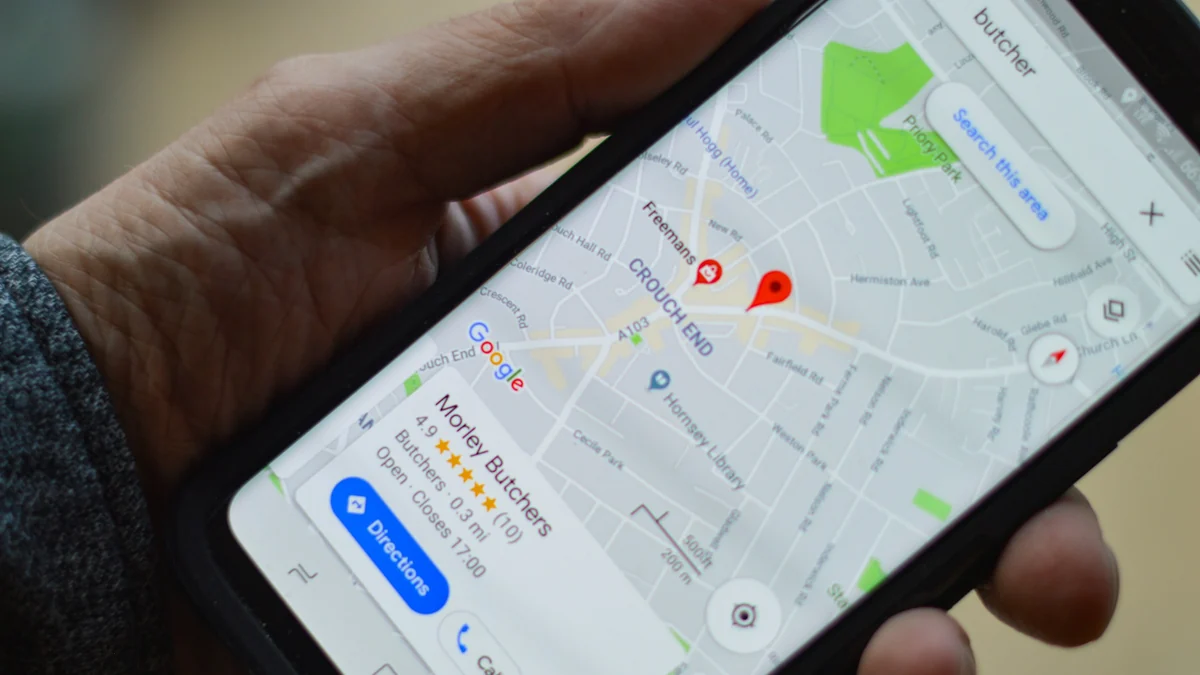
Google resolves “near me” from the device, not from the words on your website. Photo: Henry Perks.
What Google Actually Uses to Decide
Google publishes this, and it is worth quoting rather than paraphrasing. Local results are ranked on three things.
Relevance, which is “how well a Business Profile matches what someone is searching for”.
Distance, which is “how far each business is from the customer who’s searching”.
Prominence, which is “how well-known a business is”, based on information such as how many websites link to your business and how many reviews you have.
Two honest observations about that list.
First, Google states plainly that there is no way to request or pay for a better local ranking. Anyone selling you a guaranteed map pack position is selling you something Google says does not exist.
Second, distance is the factor nobody can optimise. You cannot move your unit in Bromborough closer to a customer in West Kirby. That is not a reason to give up. It is a reason to be realistic about which towns you can genuinely compete in, and to spend your effort on the two factors that are actually within your control.
Showing Up Is Only Half the Job
This is where most local SEO advice stops, and where my own Wirral research suggests the real money is being lost.
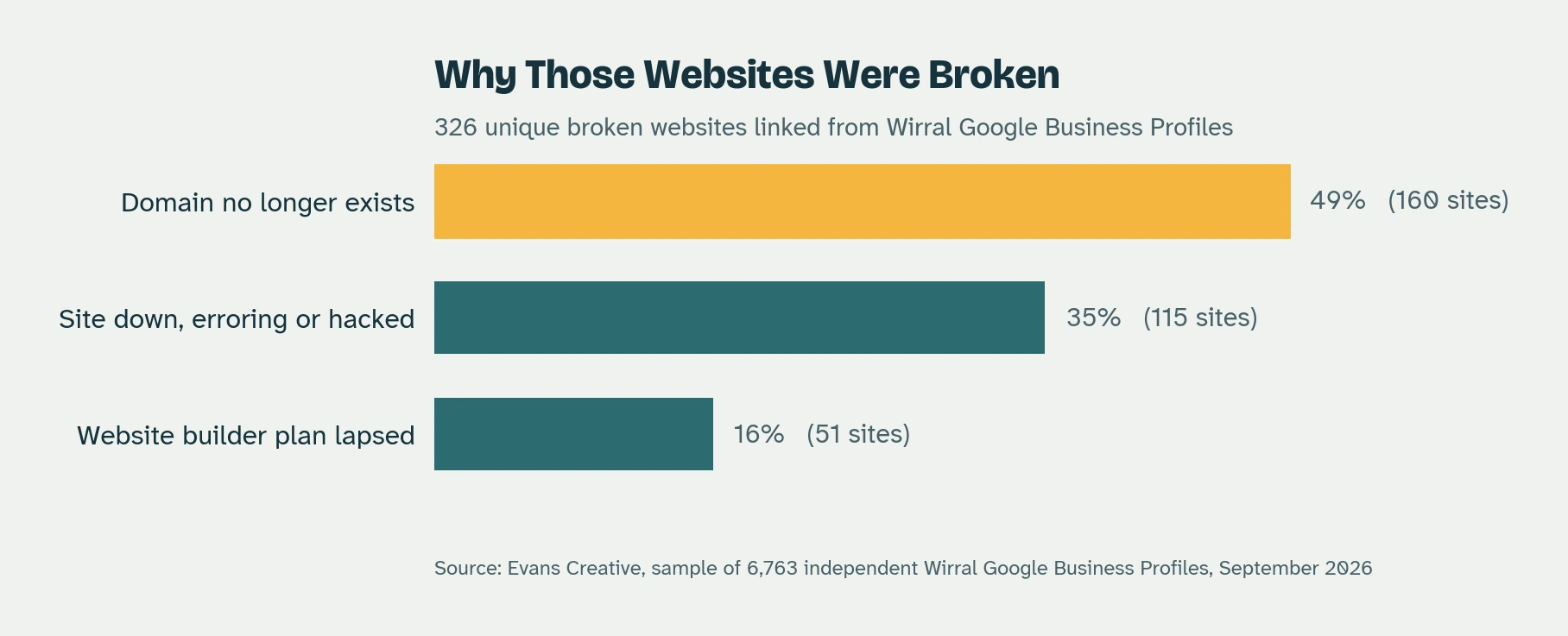
In September 2026 I checked every independent Google Business Profile I could find across the Wirral, 6,763 of them once chains and franchises were removed. Between them they link to 3,831 different websites. After screening those links automatically and then checking the flagged ones by hand, 334 profiles pointed at 326 websites that were broken.
That is 4.9% of profiles, or about one in 20. Measured against the profiles that actually link to a website, it is 8.5%, or roughly one in 12.
These were not abandoned businesses. At least 33 of them have more than 50 Google reviews, and one has 789. These are established local firms with strong profiles, winning the “near me” search, and then losing the customer at the click.
Half of the broken websites sit on a domain name that no longer exists. Source: Evans Creative study of 6,763 Wirral Google Business Profiles, September 2026.
There was also a review pattern worth reporting carefully. Businesses with a broken website had a median of eight reviews. Businesses with a working one had a median of 27. That is a correlation and nothing more. A dead website does not delete your reviews. It is more likely that both are symptoms of a business that has stopped tending its online presence.
The broken links are only part of it, too. A further 2,371 profiles have no website link whatsoever, and several hundred more point at a Facebook page or a directory listing. Put together, 46.8% of Wirral profiles do not send customers to a working website the business controls. The full breakdown, by sector and by area, is in the study itself.
The practical point stands regardless of which group you fall into. Before you spend a penny trying to rank better, click the link on your own Google profile and see where it lands.
Fix the Profile Before the Website
Your Google Business Profile is the thing being ranked in a “near me” search, not your homepage. It earns more attention than most owners give it.
Primary category. This carries more weight than almost anything else on the profile. “Bathroom remodeler” and “plumber” produce different results for different searches. Pick the one that matches what you most want to be called about, and use secondary categories for the rest.
Services and descriptions. List the actual jobs you do, in the words customers use rather than the words your trade body uses.
Hours, including bank holidays. Searches such as “open now near me” lean on this directly. A profile showing closed on a Saturday morning will not appear for a Saturday morning search, whatever else you have done.
Photos. Recent, real, and of your own work rather than a stock photograph of a smiling stranger holding a spanner.
The website link. Check it. Then check it again after any hosting change, domain renewal or site rebuild. Getting the rest of the profile right is a job in itself, which is what Google Business Profile optimisation covers.
Give Google Something to Be Relevant To
The profile is the shop window. The website is where relevance gets its evidence.
Service pages should say what the job is, who it is for, what it costs or what the price depends on, and where you do it. A page called Services that lists nine things in bullet points gives Google very little to work with, and gives a customer even less.
Location signals belong in the places they belong naturally: the towns you genuinely cover, the projects you have completed there, the customers who left reviews there. If you work across Wallasey, Hoylake and Heswall, say so on a page that demonstrates it.
What does not work is the doorway page. Nine near identical pages with the town name swapped out is a pattern Google has recognised for well over a decade, and it reads as obviously synthetic to customers too. If a location page cannot say something true and specific about that location, it should not exist.
Prominence Is Earned Locally
Prominence is the slowest of the three factors and the most durable.
Reviews are the most visible part of it. Ask consistently, ask at the point where the customer is happiest, and make it easy to do. Do not buy them and do not incentivise them. I have written separately about what Google reviews actually do for SEO.
Beyond reviews, Google looks at whether the rest of the local web agrees that you exist: mentions in local publications, sponsorship of a club or an event, listings in directories that real people use, links from suppliers and partners. A handful of genuinely local mentions is worth more than two hundred automated citation submissions, which is a service I am regularly asked to buy on a client’s behalf and regularly decline to.
Consistency matters here more than volume. Your name, address and phone number should match everywhere they appear. Where they do not, you are asking Google to work out which version is correct, and it may pick the wrong one.
A Quick Diagnostic
| What You Are Seeing | Most Likely Cause | What to Check First |
|---|
| Visible in your own searches but no enquiries | The profile is ranking fine and the click is going nowhere useful | Tap the website button on your own profile, then check the page it lands on loads and has a phone number on it |
| Visible from your premises, invisible from the next town | Distance, working exactly as designed | Whether your service area and location pages support the towns you want, and whether those towns are realistic |
| Competitors with worse reviews ranking above you | A category or relevance mismatch | Your primary category against theirs, and whether your services list matches the search |
| Ranking dropped with no changes to the site | A profile edit or suspension, or a hosting or domain problem | Profile status in Google Business Profile, then the website link |
| Appearing for the wrong type of job | Categories and services describing a different business | Primary category, secondary categories, and the wording of your service pages |
Measure the Right Thing
Map pack positions vary by a few hundred metres. Two people on the same street can see different results. Tracking a single rank number is close to meaningless.
What is worth tracking is what the profile produces: calls, direction requests, website clicks, messages, and the quality of the enquiries that follow. Google Business Profile reports most of this for you.
If calls are up and enquiries are not, the problem is usually further down the chain, on the page the click lands on. That is the whole argument of this article in one sentence. Visibility is not the outcome. The enquiry is.
Not Showing Up, or Not Getting Called?
If you run a Wirral business and are not sure which of the two is happening, I can check the profile, the website it points at and the pages that are meant to be doing the work as part of a local SEO audit, then tell you in plain English what to fix first.
If the answer turns out to be that you do not need me, I will tell you that instead.
Local SEO Audit