I checked 6,763 Wirral business profiles on Google and looked at every website that did not load.
334 of them send customers to a website that does not work. That is about one profile in every 20, and roughly one linked website in every 12.
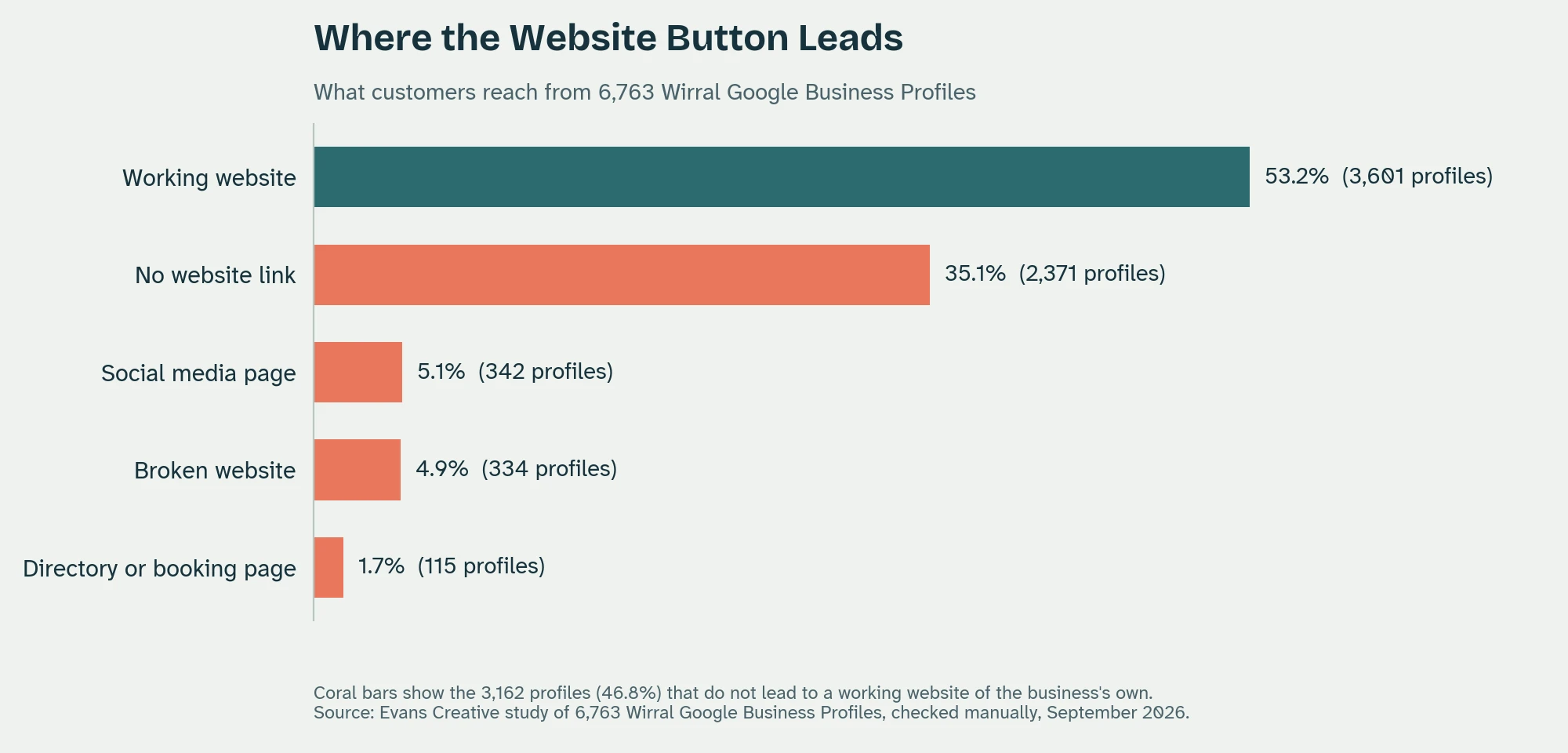
Look at the full picture and it gets worse. Nearly half of the profiles I checked do not lead customers to a working website of the business’s own.
The Short Version
- I checked 6,763 Google Business Profiles for independent Wirral businesses, which between them link to 3,831 websites.
- 334 profiles link to one of 326 broken websites. Customers who tap the website button get an error, an expired site or nothing at all.
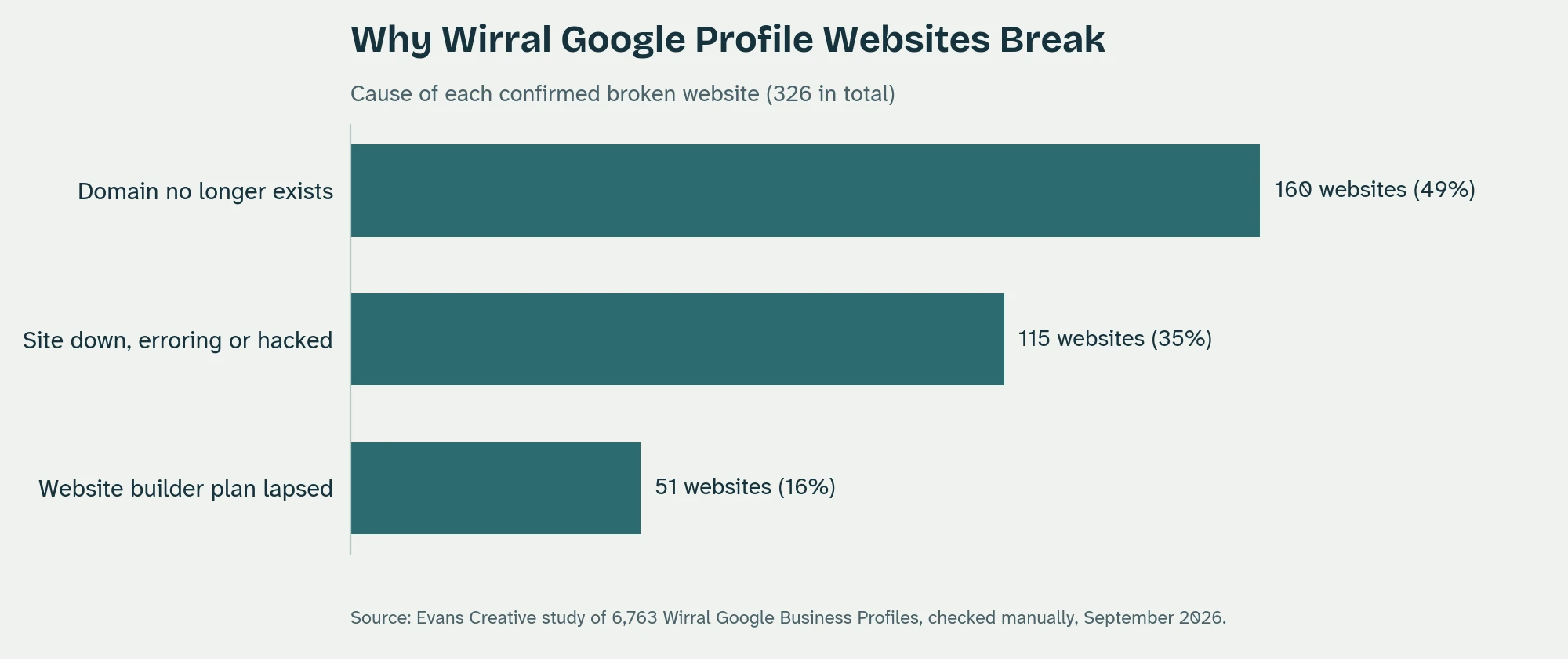
- The most common cause is a domain name that no longer exists (49% of broken websites). Next come sites that are down, erroring or compromised (35%), then website builder subscriptions that have lapsed (16%).
- A further 2,828 profiles (41.8%) do not link to a website of the business’s own at all. Most have no website link, and the rest point to a Facebook page, a directory or a booking page.
- Put together, 3,162 of the 6,763 profiles (46.8%) do not send customers to a working website the business controls.
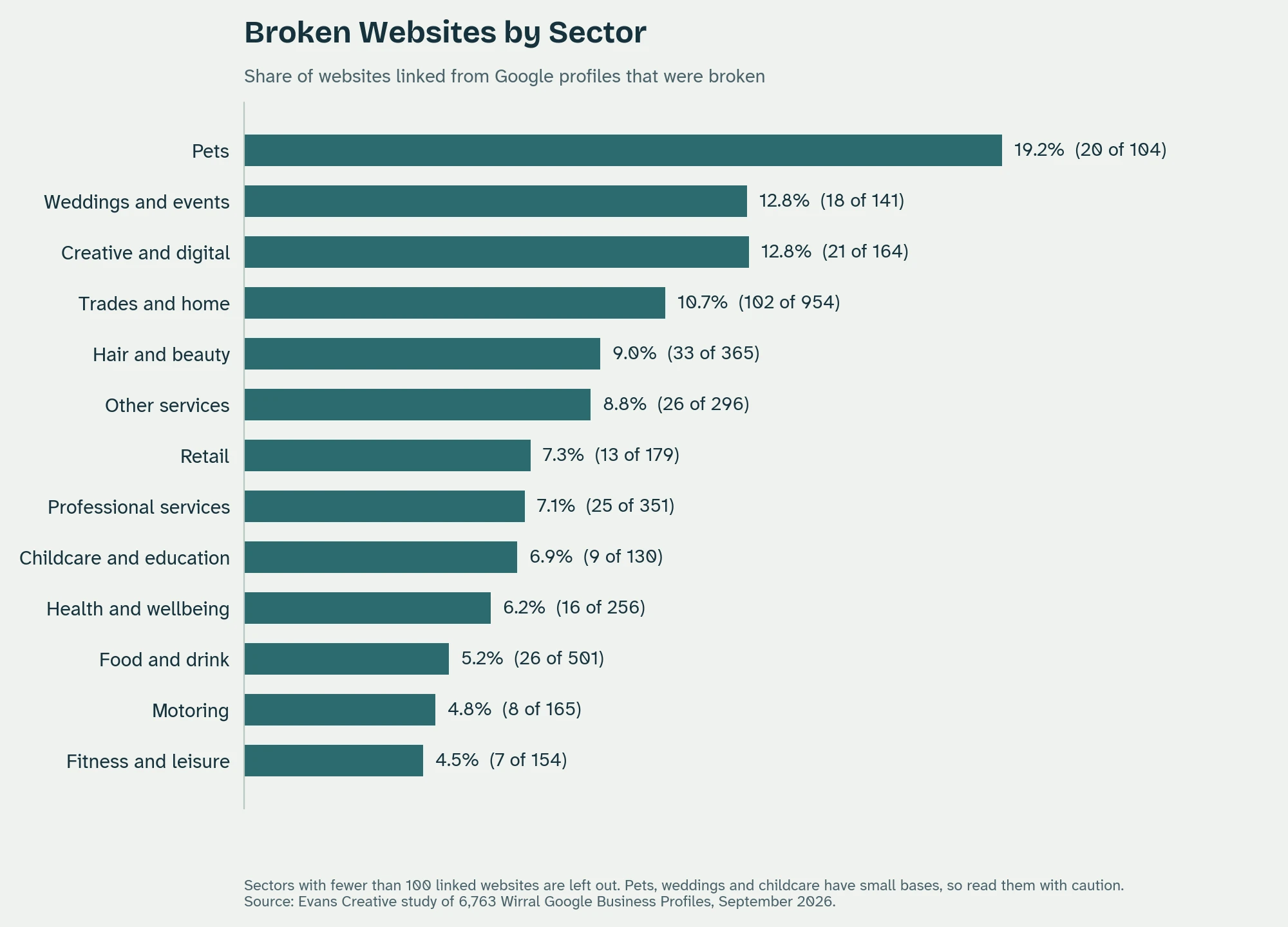
- Trades and home businesses had the most broken websites, with 102. Pets businesses had the highest rate, at 19%.
- Many of these businesses are clearly still trading. At least 33 of the profiles with a broken link have more than 50 Google reviews, and one has 789.
- The fix usually takes a few minutes. Search for your business name, tap the website button and see what happens.
Why a Broken Link on Your Google Profile Matters
For a lot of local businesses, the Google profile is the shop window. It shows up when someone searches for the business by name, and it shows up in the map results when someone searches for a plumber or a dog groomer nearby. It carries the reviews, the opening hours, the phone number and a button that says Website.
That button is where interested people go next. BrightLocal’s 2026 consumer survey of 1,002 US adults found that 54% of people visit a business’s website after reading positive reviews. That is a US sample, so treat the exact figure with some care, but the behaviour will be familiar to anyone who has looked at local search data. Someone reads the reviews, likes what they see, and taps through to check prices, look at previous work or find a contact form. Reviews do a lot of the persuading here, and I have written separately about whether Google reviews help SEO.
If that tap leads to an error page, the business loses the enquiry at the moment the customer was most ready to make one. The business owner almost never finds out. Nobody clicks their own website button. Customers do.
This is why I think of it as a revenue problem before it is a rankings problem. There is no point working on where a profile appears in search if the people who find it hit a dead end.
How I Ran the Study
The sample started with a list of Wirral businesses I built on 16 and 17 September 2026. It combines Google Maps searches across more than 100 business categories and 12 Wirral towns with OpenStreetMap, the Food Standards Agency hygiene register and the Care Quality Commission register. I merged duplicates and removed national chains, franchises and non-commercial organisations such as schools, churches and councils.
That left 6,763 independent businesses with a Google Business Profile. Between them they link to 3,831 different websites. Where several profiles pointed to the same website, I counted that website once.
I then checked every link in three stages:
- An automated check. A script requested the homepage of every linked website and recorded whether it loaded. Anything that failed to connect, timed out or returned an error was flagged.
- A domain lookup. For every flagged link, I checked whether the domain name still exists and points to a server.
- A manual check. I opened every flagged link in a browser and recorded what a customer would actually see.
The manual check matters. Automated tools are easily blocked by security plugins and slow servers, and 209 of the flagged websites turned out to work perfectly well in a browser. I have not counted those as broken. I also removed a small number of chain websites the earlier filters had missed.
A few limits are worth stating plainly. This is a snapshot taken in September 2026, and some of these businesses may have fixed their links since, or closed. The sample is large, but it is not a complete list of every Wirral business, because it depends on the categories searched and the registers used. And I have not named any of the businesses involved. The point is the pattern, not the individual firms.
What the Data Found
Of the 6,763 profiles, 334 link to a broken website. A handful of businesses share a website across more than one profile, so those 334 profiles point to 326 different broken websites.
- As a share of all profiles: 4.9%, or about one in 20.
- As a share of all linked websites: 8.5% (326 of 3,831), or roughly one in 12.
The rest of this study works with the 326 websites, so that a business with two profiles is not counted twice.
Nearly Half of Profiles Do Not Lead to a Working Website
Broken links are only part of the story. When I looked at where the website button leads on every one of the 6,763 profiles, the picture was this:
Only just over half of Wirral Google profiles send customers to a working website the business owns. Source: Evans Creative study of 6,763 Wirral Google Business Profiles, September 2026.
| Where the Website Button Leads | Profiles | Share |
|---|
| A working website of the business’s own | 3,601 | 53.2% |
| No website link at all | 2,371 | 35.1% |
| A social media page, usually Facebook | 342 | 5.1% |
| A broken website | 334 | 4.9% |
| A directory or booking platform page | 115 | 1.7% |
That means 3,162 profiles, or 46.8%, do not send customers to a working website the business controls.
The biggest group by far is the 2,371 profiles with no website link at all. I cannot tell from the profile whether each of these businesses has a website somewhere that they have simply not added, or no website at all. From the customer’s point of view it makes no difference. There is no button to press.
Some sectors lean on their Google profile far more than others. In hair and beauty, 66% of profiles do not link to a website of the business’s own, and 47% have no website link of any kind. Pets businesses were at 56%. At the other end, only 29% of professional services and health and wellbeing profiles, and 28% of childcare and education profiles, did not link to a website of their own.
Why the Websites Break
Every broken website I found fell into one of three groups, and they are not equally easy to fix.
Nearly half of the broken websites sit on a domain name that no longer exists. Source: Evans Creative study of 6,763 Wirral Google Business Profiles, September 2026.
The Domain No Longer Exists: 160 Websites (49%)
This was the most common problem by some distance. The website address on the profile no longer points anywhere, so the browser shows a message such as “This site can’t be reached” or “DNS_PROBE_FINISHED_NXDOMAIN”. In most cases, the domain name registration has lapsed.
It is an easy thing to let slip. A domain is often bought once by whoever built the first website, renewed automatically on a card that later expires, and then forgotten. For .uk domains, Nominet suspends the domain 30 days after it expires. The owner can still renew it up to 90 days after expiry, and at 95 days it is released for anyone to register. Once that happens, the business has no control over what appears at that address.
The Site Is Down, Erroring or Compromised: 115 Websites (35%)
In these cases the domain still exists, but the website does not work. The browser shows a server error, a hosting account suspension notice or a security warning, or the page simply refuses to load. This group also covers sites that looked as though they had been compromised.
The usual causes are hosting that has stopped being paid for, a hosting company that has closed an old account, or a website that has not been updated for years and has broken or been compromised. From the customer’s side, the result is the same as a missing domain: no website.
The Website Builder Plan Has Lapsed: 51 Websites (16%)
These businesses built their site on a platform such as Wix, Squarespace or Shopify, and the subscription has ended. Of the 51, 42 were on Wix, six on Squarespace and three on Shopify. Instead of the business’s website, the customer sees the platform’s own notice that the site is unavailable or has expired.
Squarespace, for example, keeps a site visible for 15 days after a payment fails and then takes it offline to the public and to search engines. For domains bought through Wix, the domain is disconnected from the site during a grace period of around 30 days after it expires.
This is the most fixable group of the three. The website usually still exists inside the account, so paying for the plan again often brings it back.
Which Sectors Are Worst
Pets businesses had the highest rate, with 20 broken websites out of 104 (19.2%). That base is small, so I would not read too much into the exact figure, but the gap to the next sector is large. Weddings and events and creative and digital businesses were next, both at 12.8%.
Pets, weddings and events, and creative businesses had the highest rates, although some of these groups are small. Source: Evans Creative study of 6,763 Wirral Google Business Profiles, September 2026.
Trades and home businesses had the most broken websites in absolute terms, with 102. That is nearly a third of all the broken websites in the study. Plumbers, roofers, builders and gardeners rely heavily on people finding them through Google and then checking their work before getting in touch, so a broken link costs them more than most.
At the other end, food and drink (5.2%), motoring (4.8%) and fitness and leisure (4.5%) had the lowest rates among the larger sectors.
I do not have data on why the rates differ, so treat this next part as a reasonable guess rather than a finding. The sectors near the top have a lot of sole traders and small operators, who often set up a website once, pay for it on a personal card and have nobody whose job it is to notice when it stops working. The sectors near the bottom include more businesses with premises, staff and suppliers who are likely to spot a problem.
Which Areas Are Worst
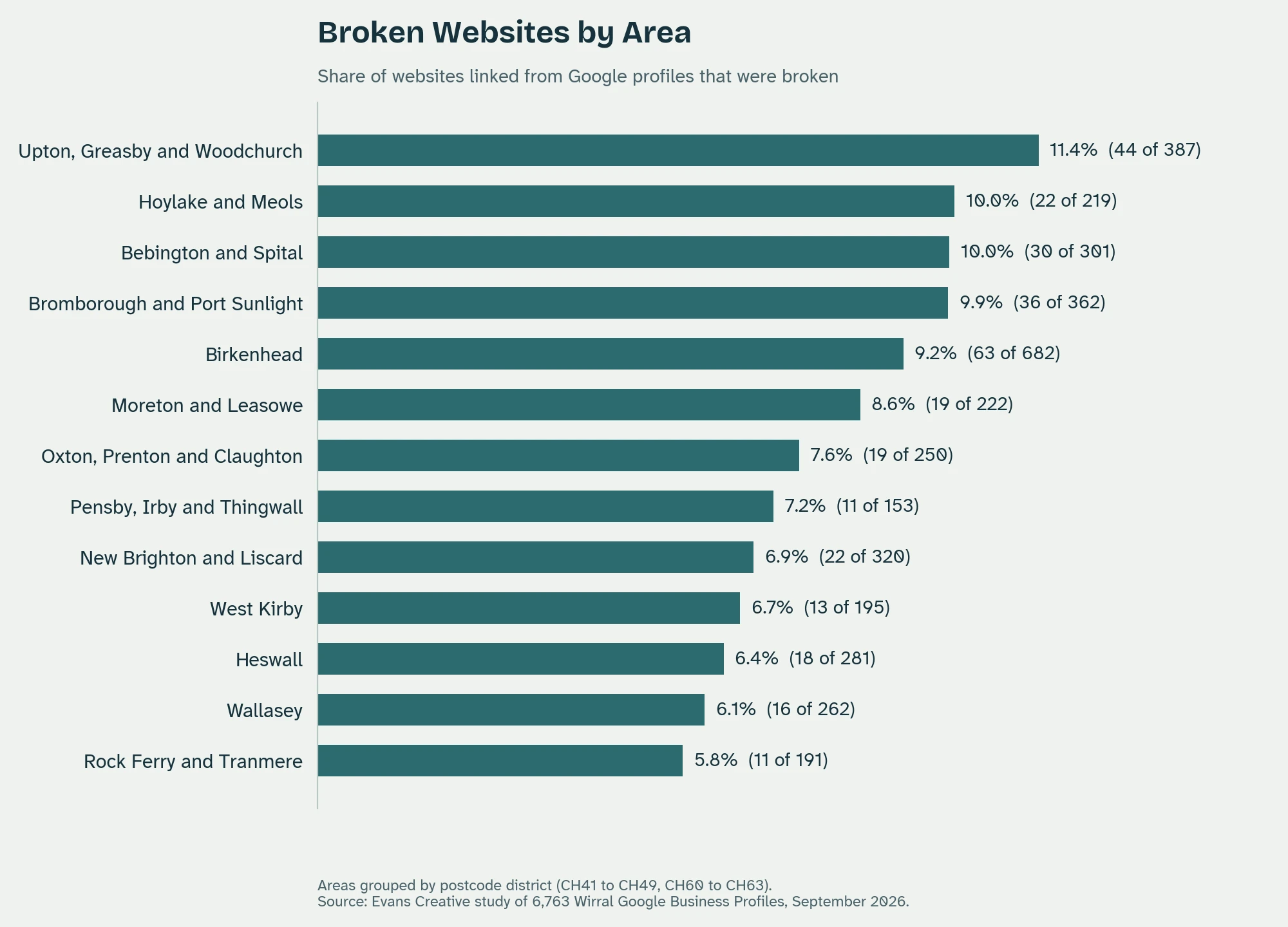
Upton, Greasby and Woodchurch had the highest rate, at 11.4%. Hoylake and Meols and Bebington and Spital followed, both at 10.0%. The lowest rates were in Rock Ferry and Tranmere (5.8%), Wallasey (6.1%) and Heswall (6.4%).
The gap between the best and worst areas is smaller than the gap between sectors. Source: Evans Creative study of 6,763 Wirral Google Business Profiles, September 2026.
The spread between areas is narrower than the spread between sectors, and some of it will reflect the mix of businesses in each area rather than anything about the area itself. An area with a lot of trades businesses will tend to score worse, because trades score worse everywhere.
Do Broken or Missing Links Go With Fewer Reviews?
Businesses with a broken website had a median of eight Google reviews. Businesses with a working website had a median of 27. Profiles with no website link at all were much the same as the broken group, with a median of nine reviews, and 34% of them had no reviews whatsoever, against 13% of profiles with a working website.
It would be easy to turn that into a headline about websites winning reviews, but the data does not show that. Newer and smaller businesses tend to have fewer reviews and are also more likely to have a website that has been left to lapse. The two things travel together. One does not necessarily cause the other.
What the data does show is that plenty of these businesses are still trading and still well regarded. Their average rating was 4.73, slightly higher than the 4.68 for businesses with a working website. At least 33 of the businesses with a broken website have more than 50 reviews, and one has 789. These are not abandoned listings. They are active businesses whose customers are happy with them, sending new customers to a page that does not work.
Why Your Google Profile Should Link to Your Own Website
If you have a website, it belongs on your Google profile. Leaving it off, or pointing the button at a Facebook page or a directory listing, gives away some of the value the profile creates. There are four reasons I would not leave it to chance.
Customers go looking for it. As mentioned above, BrightLocal found that 54% of consumers visit a business’s website after reading positive reviews. A profile with no website button leaves those people to search for you again, and the next result they see may well be a competitor.
A profile can only say so much. It holds your hours, your reviews, some photos and a short description. It is not built to explain what a full rewire costs, show twenty before and after photos of a garden, or walk someone through how a first appointment works. Those are the things that turn a browser into an enquiry, and they need a page of their own.
Other platforms are not yours. A Facebook page or a directory listing sits on somebody else’s platform, under their rules and their design. Directory pages often show other businesses alongside yours. Google Business Profile has its own separate place for social media links in some regions, so the website field does not need to double as your Facebook link.
Google looks at links when deciding which businesses to show. Google’s own guidance says local results are based mainly on relevance, distance and prominence, and that prominence is “based on info like how many websites link to your business and how many reviews you have.” Earning links is far easier when there is a website of your own for other sites to link to. Getting the profile itself right is the other half of the job, which is what Google Business Profile optimisation covers.
No Website Yet? Here Is Why You Need One
A good Google profile can win a business plenty of work on its own, and I would never tell a busy tradesperson with a full diary that they must have a website tomorrow. But relying on the profile alone carries real risks.
You do not own the profile. Google decides what it shows, how it looks and what the rules are. A profile can be edited, restricted or suspended, and when that happens a business with no website has nowhere else for customers to find it.
It is where people check you out. Local customers often compare two or three businesses before getting in touch. A website is where you can show your prices or how you quote, your previous work, your qualifications and why someone should pick you. BrightLocal’s 2026 report notes that only 40% of local businesses have a dedicated website, which it says means many consumers “could be dropping off at this point in the funnel”.
It keeps working when your social media goes quiet. A Facebook page is only as current as its last post. A simple website with your services, area, contact details and some examples of your work stays useful for years with very little upkeep.
It does not need to be big. A small business does not need a 40 page website. A handful of clear pages covering what you do, where you do it, what it costs or how pricing works, examples of your work and how to get in touch will cover what most customers want to know, and it costs less than many people assume. I have set out what a small business website costs in the UK if you want the figures.
How to Check Your Own Profile in Two Minutes
- Search for your business name on Google, on your phone, as a customer would.
- Tap the Website button on your profile. Check that it opens your current website, not an error, an expired site notice or an old page. If there is no Website button, add your website to the profile.
- Do the same on a computer, because a site can work on one and not the other.
- Check when your domain name renews. Log in to wherever you bought it and make sure auto-renew is switched on with a card that has not expired.
- Check who pays for your hosting or website builder plan, and that the payment details are current. If a former web designer or a previous business partner set it up, find out whose account it is in.
- Put a reminder in your calendar to repeat this every few months, or hand the whole job to whoever looks after your website.
If the link needs changing, open your profile in Google Search and select Edit profile, or in the Google Maps app go to Business, then Edit profile. Google reviews edits before they go live, so the change may not appear straight away.
What I Would Fix First
| Problem | What the Customer Sees | The Fix |
|---|
| Domain has lapsed but is still within the renewal window | “This site can’t be reached” | Renew the domain with the registrar. For .uk domains this is possible up to 90 days after expiry. |
| Domain has lapsed and been released | “This site can’t be reached”, or someone else’s website | Register a new domain, point it at your website and update the link on your Google profile straight away. |
| Hosting suspended or unpaid | A suspension notice or server error | Contact the hosting company, settle the account and get the site restored or moved. |
| Website broken or compromised | An error page, a security warning or unrelated content | Take the site offline, have it cleaned or rebuilt, and change every password connected to it. |
| Website builder plan has lapsed | The platform’s own “site unavailable” notice | Log in and renew the plan. The site is usually still in the account. |
| Profile links to a directory or Facebook page | Somebody else’s page | Link to your own website if you have one. |
| No website link on the profile | No Website button at all | Add your website if you have one. If you do not, a simple site of a few pages is worth considering. |
Want Me to Check Yours?
If you run a Wirral business and are not sure whether your Google profile and website are working as they should, get in touch. I can check the link, the website behind it and the basics of the profile itself as part of a local SEO audit, and tell you in plain English what needs fixing first.
If you do not have a website yet, I build straightforward websites for local businesses, and Google Business Profile setup is included, so the two work together from day one.
Local SEO Audit