Ask five web designers what a website costs and you will get five different answers, and at least two of them will dodge the question until you have had a quick chat about your goals first.
That is not really about your goals. Vague pricing keeps the conversation open long enough to build some rapport, and rapport is a lot easier to charge for than a website is.
So here is a straight answer on website design costs in the UK in 2026: what a small business site actually costs, what changes the number, and what is really going on when two people quote wildly different prices for what sounds like the same job.
What a Small Business Website Actually Costs in the UK
| Price | What It Buys |
|---|
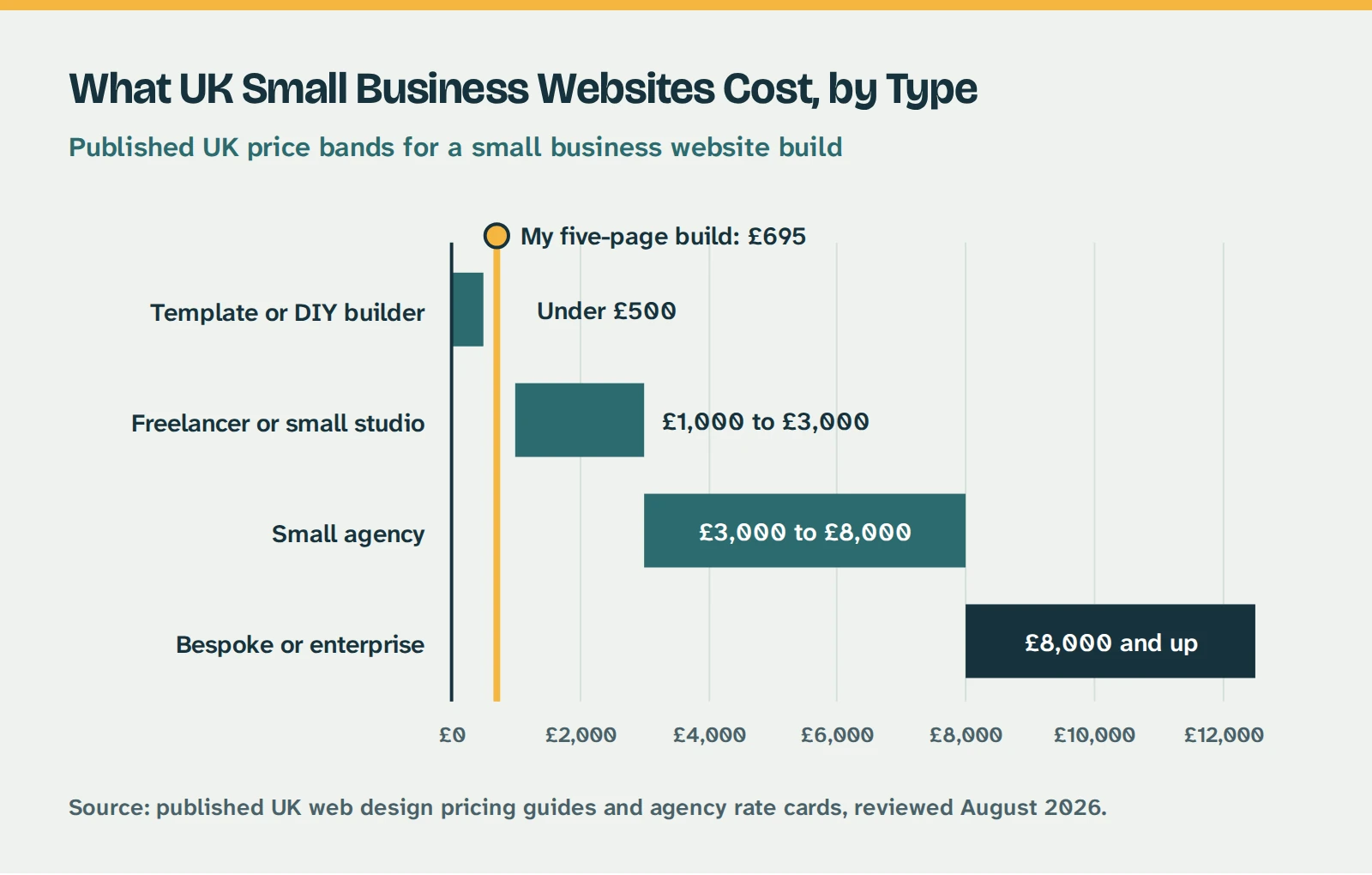
| Under £500 | A template site, built quickly, rarely with any custom design. |
| £695 | Where I sit. A proper five-page WordPress build, one person, real design time. |
| £1,000 to £3,000 | More custom design and content support, typically still one or two people. |
| £3,000 to £8,000 | A small studio or agency. A team, a structured process, overheads built into the price. |
| £8,000 and up | Bespoke builds, complex integrations, or ecommerce at real scale. |
Those bands come from checking a spread of published UK pricing guides and agency rate cards, not from one source with an axe to grind. My own prices are published in full on my website design page, which is more than most will do.
The published UK price bands for a small business website, with my £695 five-page build marked.
What actually separates those bands is not polish. Most competent people can make a page look decent in 2026. It is who is doing the work, how much of their time you are paying for, and how much of the fee goes towards things that never touch your website.
What Pushes the Price Up
A handful of things reliably move a quote, whoever you ask:
- More pages. A five-page site and a fifteen-page site are different jobs, and the price tracks that fairly closely once you are past the basics.
- Ecommerce. Selling online means a shop, payment processing, and product pages that need building and photographing. A lean setup starts from around £2,500 and a large catalogue goes a long way past that.
- Integrations. Booking systems, CRMs, email marketing tools. Each one is scoping, testing, and something that can break later.
- Bespoke functionality. Anything that is not content on a page: custom calculators, member logins, anything built rather than configured.
Where the Money Actually Goes
Nobody itemises this bit, so here is mine.
For a typical five-page site I budget roughly a day per page: working out what the page actually needs to do, writing or refining the copy if you have not got it already, building it properly in WordPress, then checking it works on a phone and not just a laptop screen. That is five days across a standard build, plus time upfront to understand what your business needs the site to do, and time at the end to test everything together and get it live.
What Web Designers Charge for That Time
YunoJuno’s 2026 Contractor and Freelancer Rates Report, built from more than 182,000 contractor and booking data points, puts the average UK freelance day rate at £385 for designers and £533 for software engineers. Building a small business site in WordPress sits somewhere between the two.
Five days at the designer rate comes to just under £1,900. I charge £695, so the obvious question is what is missing. The answer is in the next section, and it is not the work.
Why £695 Is Not Suspiciously Cheap
£695 sounds too good to be true if you are picturing a normal design business. A studio with an office, an account manager and a project management subscription genuinely cannot build a five-page site for that and still pay everyone. Their price reflects real costs. Those costs just never touch your website.
I do not have any of that. It is me, a laptop, and a handful of tools I actually use. That is not a gap I am hiding. It is the entire reason the number works.
It also means the price is not a loss leader that creeps up once you are locked in. £695 is £695, whether you are my first client this month or my fiftieth.
Rates across the sector are not moving much anyway. IPSE research carried out by YouGov across just over a thousand self-employed people found that 55% had not changed their day rate in the past year, and 58% expected to freeze it again. Whatever anyone tells you, nobody is about to reprice this market upwards, so there is no reason to rush a decision.
What Happens After the Build
The build price is a one-off. It does not cover what keeps the site running afterwards, and this is the part where UK pricing genuinely is that wide.
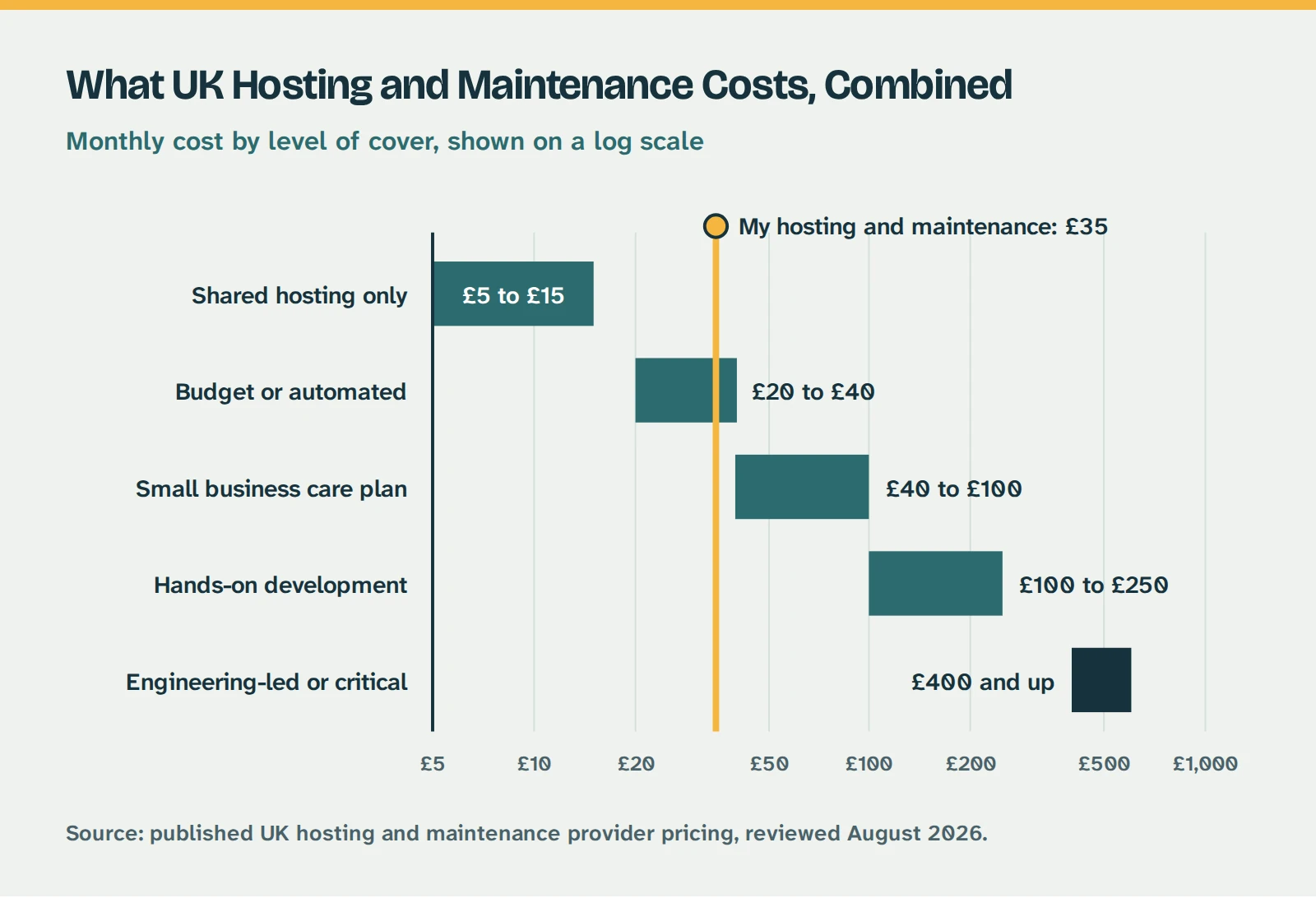
UK hosting and maintenance costs, combined into one monthly figure on a log scale, with my £35 plan marked.
Shared hosting with nobody looking after it starts around £5 a month, and that is server space and nothing else. A proper care plan, where an actual person is involved rather than an automated script, typically starts around £40. Past £100 you are paying for real development hours and faster response times. Past £400 you are into engineering-led cover, the kind of thing ecommerce and booking-critical sites need.
So budget for:
- A domain name. Roughly £10 to £15 a year for a .co.uk.
- Hosting and maintenance, combined. Somewhere in the bands above, depending on how hands-on you want it. Mine sits at £35 a month, and I have written up the full case for that number separately if you want the detail.
- Ongoing content or SEO, if you want the site to keep working for you rather than sit still. That is a separate service, and a separate cost, from either of the above.
None of this should come as a surprise partway through a project. If a quote does not mention it, ask.
When I Am the Wrong Choice
If you are running a large catalogue ecommerce store, need a dedicated project manager, or need a team that can pick up work if I am off sick or on holiday, I am not the right fit. I will tell you that upfront rather than take the job and let you find out three months in.
I work alone. That is the trade-off behind the price, and it is worth being honest about before you commit rather than after.
DIY, Freelancer or Agency
DIY builders make sense if your budget is genuinely close to zero and you have real time to spend learning the platform. You will spend more hours on it than you expect, and the site can be harder to move elsewhere later if you outgrow it.
A freelancer, which is what I am, gets you a proper build without agency overheads, in exchange for one person’s availability rather than a team’s.
An agency earns its price once you need more than one person can realistically deliver: a bigger team, a dedicated project manager, cover when somebody is away. For some businesses that structure is worth every penny of it.
How to Reduce the Cost Without Cutting Corners
A few ways to bring the number down without ending up with a worse site:
- Bring your copy already written, or at least drafted. Writing content from scratch eats more time than almost anything else in a build.
- Keep the page count honest. Five good pages beats twelve thin ones, and costs less.
- Skip features you will not actually use. A booking system nobody clicks is a cost with no return.
- Choose a template-based build over a fully bespoke one, if your brand does not need to look completely unlike everyone else’s.
- Work with a low-overhead freelancer rather than a larger studio, if a single point of contact suits how you like to work.
None of these mean a worse website. They mean not paying for things that do not move the needle for a small business.