Paul Campbell is an electrician. Before I rebuilt his website, he was running it through GoDaddy’s website builder. Afterwards, his site moved up more than 50 places in Google. That is not a marketing line, it is what he wrote in his own review.
That jump did not happen because GoDaddy is a bad tool. It happened because nobody, including Paul, knew there was a problem until something forced the comparison. That is the actual subject of this post: not whether DIY builders are good or bad, but whether you can tell the difference from inside one.
Website builders like Wix, Squarespace, GoDaddy and Canva have a genuine place. They are cheaper to start, faster to launch, and for plenty of businesses, entirely the right call. This is not an argument against them. It is an honest look at what they can and cannot tell you, so you can work out which side of that line your own business is on.
The Short Version
- DIY builders like Wix, Squarespace and GoDaddy are genuinely the right call for testing an idea, a hobby project, or a tight budget.
- What none of them can tell you is whether the site is actually working. It looks finished either way.
- A professional build costs £695 upfront and usually earns that back the first job it brings in that the DIY version would not have.
- One client moved from GoDaddy’s builder to a proper rebuild and climbed 50+ places in Google. Nothing in his old dashboard ever flagged a problem.
What a DIY Website Builder Actually Gives You
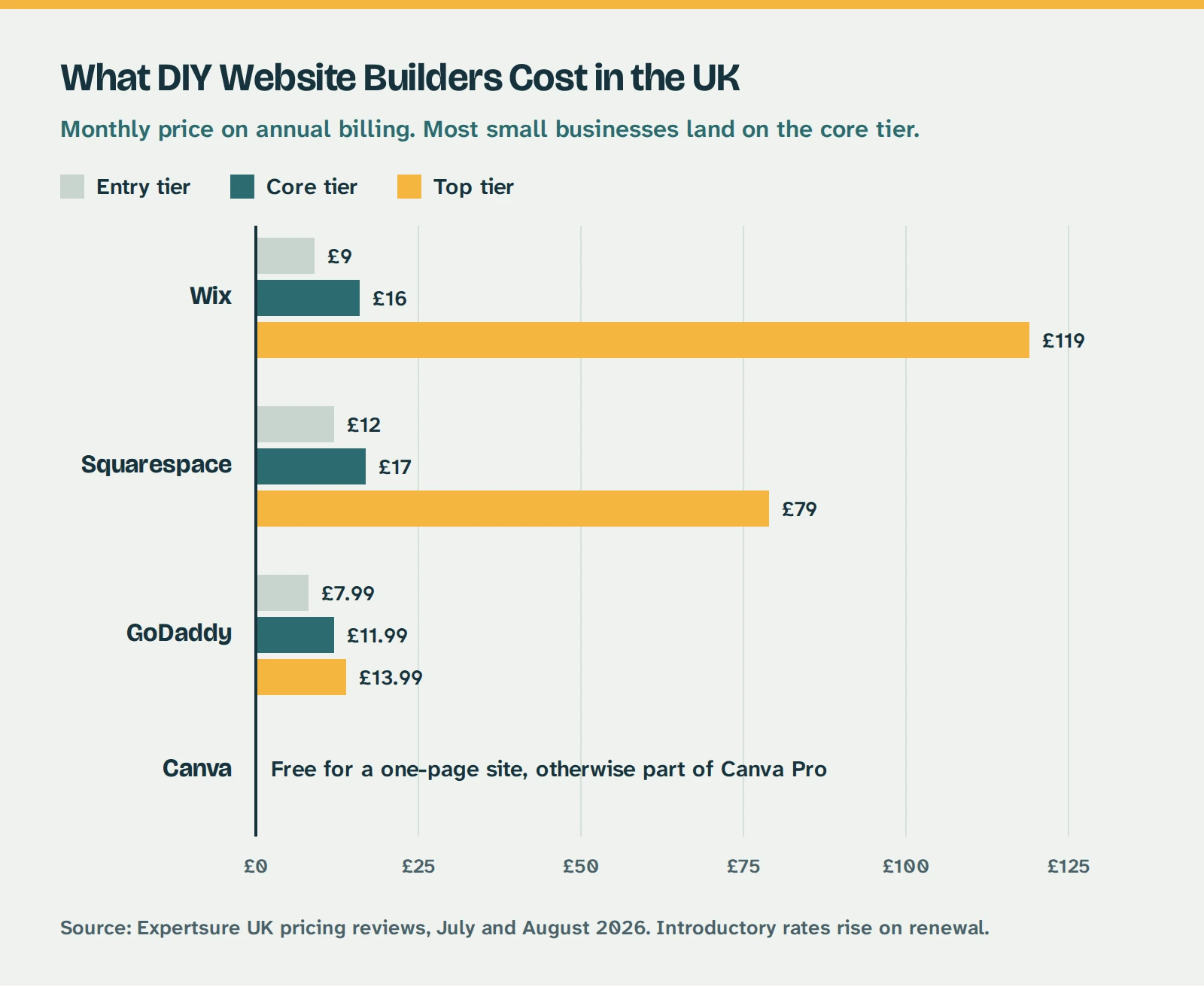
The building blocks have genuinely improved. Wix and Squarespace both offer polished templates now, not the recognisably-templated sites of ten years ago, and Wix’s AI tools can put together a working draft from a short description in a few minutes. Squarespace’s Core plan (£17/month) includes proper ecommerce tools as standard, not an afterthought bolted on. Canva, mostly known for graphics, now offers a free one-page website builder too, which is probably the single most common way small business owners in trades and local services end up with something online, without ever quite meaning to build a website at all.
What you get for that: your own hands on every decision, a live site within days rather than weeks, and a monthly cost that starts at nothing.
What you do not get is anyone checking your working. The template stops your site looking actively broken, but nothing in the tool tells you whether the copy makes sense to a stranger, whether the pages are structured in a way search engines can follow, or whether someone on their phone can actually find your number. You are the designer, the copywriter and the SEO, whether or not you signed up to be.
What the main DIY website builders cost per month in the UK on annual billing. Source: Expertsure, 2026.
What You Are Actually Paying For With a Professional
£695 is not a website builder subscription with a person attached. It is a different thing entirely: someone doing the parts of the job you would otherwise have to learn from scratch, at 11pm, after a full day’s work.
That is the plain version. The fuller version is that a properly built site starts with a structure search engines can actually read, page titles and copy written to answer what someone is actually searching for, and a design built around what your business does rather than what a template allows. None of that is exotic work. It is just work that either happens before the site goes live, done by someone who does it every day, or it does not happen at all, because you are a locksmith or a hairdresser with a business to run, not a web designer.
The other part of what you are paying for is simpler: your evenings back. The going estimate for a proper DIY build, learning the platform included, is 20 to 40 hours. That is time that is not going into the actual business, and it is the trade you are making either way, whichever direction you choose.
Where DIY Genuinely Wins
This part matters, so it is worth saying plainly: for some businesses, a builder is the right call, not a compromise.
If you are testing whether an idea has legs before spending anything serious on it, a builder gets you a live site this weekend, for £15 or £20 a month. If your business is genuinely seasonal or short-lived, a market stall, a pop-up, a one-off event, £695 and a proper build does not make sense against however many weeks you will actually use it. And if you enjoy the process, if building the site is part of the fun of starting the business rather than a chore standing between you and starting it, that is a completely legitimate reason to DIY, full stop.
There is also genuinely less to think about day to day. Hosted builders handle their own security and updates in the background, which is real, uncomplicated peace of mind that a self-hosted WordPress site does not have. (More on what that actually involves in How Often Does a Website Actually Need Maintenance?)
None of these readers need a professional. If that is you, a builder is the right answer, and the rest of this post will not change that.
What a Website Builder Will Not Tell You
Here is the part no builder’s dashboard will ever show you: whether the site is actually working.
Paul Campbell is an electrician. His site was live on GoDaddy’s website builder, it looked reasonable, and by every visible measure it was doing its job. Nothing in the dashboard flagged a problem. There was no warning, no red banner, no obvious sign that anything needed fixing. I rebuilt it in WordPress, and it moved up more than 50 places in Google afterwards.
“Evans Creative redesigned my electrical website and it jumped up 50+ places in the Google listing. Excellent service, would highly recommend.”
Paul Campbell, Electrician
That gap, between looking fine and actually bringing in work, is invisible from inside a builder. Nothing notifies you that your page titles do not match what people search for, or that your site structure is quietly working against you, or that a competitor two streets over is getting calls that should be yours. The tools that would tell you are the same tools a professional uses to check, and checking is not part of what a builder gives you.
This is not really about GoDaddy specifically, or Wix, or Squarespace. It is the nature of any DIY tool: it is built to help you publish, not to tell you whether publishing worked.
The Real Cost Comparison
| DIY Website Builder | Professional Designer |
|---|
| Upfront cost | Lower, £0 to £25/month | Higher, £695 one-off |
| Time to launch | Entirely down to you | Under a week, off your plate |
| Design starting point | A template, with real limits | Built around your business |
| What it is built to do | Get you online | Get the phone ringing |
| SEO groundwork | Down to you to learn and do | Built in from day one |
| Genuinely good for | Testing an idea, a hobby project, a tight budget | A business that needs the site to bring in work |
Compare the sticker prices and DIY wins easily: £16 a month against £695 upfront looks like a simple decision. That is comparing the wrong two numbers.
The real comparison is upfront cost against what the site actually earns you. A £16-a-month site that nobody finds, or that finds you but does not ring, is not a saving. It is a cost, just paid differently, in enquiries that went to a competitor instead of you. A £695 site that gets found and gets the call usually earns back the difference within the first job it brings in.
“Cheaper” and “cheaper overall” are not the same claim, either. Every builder covered here runs a version of the same pattern: a low headline price that rises once the introductory period ends. Wix’s promotional rates revert to the full headline price after the first billing term, and GoDaddy’s renewal price climbs too, by how much depends who you ask. Run that forward two or three years and the gap to a one-off £695 build narrows a long way, before you have even weighed up whether the site is doing its job.
For the full breakdown of what £695 covers and where the money actually goes, see How Much Does a Website Cost for a Small UK Business?
How to Decide
A few honest questions, roughly in order of how much they should matter:
- Does new business depend on people finding you and calling, or do you get work through referrals and repeat custom regardless? If it is mostly referrals, the site matters less, and DIY is probably fine.
- How much time do you actually have, not how much you would like to have? Twenty to forty hours is the realistic range for a proper DIY build, on top of everything else you are already doing.
- Does the business need the site working from day one, or is this a soft launch you can improve over time? A tight opening date favours getting it right first, not fixing it later.
- Do you enjoy this kind of work, or does it feel like a chore standing between you and actually running the business? If it is the second one, that is worth being honest with yourself about.
- What happens if you outgrow the template? Some businesses never do. Some outgrow it within a year, and rebuilding from scratch later usually costs more than building it properly the first time.
Not Sure Which One Is Right for You?
Tell me a bit about the business and I will give you a straight answer, including if a DIY builder is genuinely the better call. No sales pitch, no discovery call unless you want one.
Get in Touch