There is a sentence I have heard in nearly every first conversation I have ever had with a small business owner, and it is usually said with a certain amount of pride.
“We have never had to advertise. It is all word of mouth.”
Most of the time it is true, and it deserves the pride. A business that has grown for a decade on recommendations alone has done something that no amount of budget can buy. People liked the work enough to put their own reputation behind it in front of a friend. That is the hardest thing in commerce to earn and the easiest thing in the world to lose.
Then comes the second half of the sentence, which is the part I have a problem with.
“So I do not really need a website, or any of that SEO stuff.”
That is where a description of the past quietly turns into a plan for the future, and the plan has a hole in it. Not because word of mouth is weak. Because there are two things word of mouth cannot do. It cannot produce more referrals than your existing customers happen to give you, and it cannot control what the person on the receiving end finds when they look you up. They always look you up.
The Short Version
- Word of mouth is the most trusted marketing there is. That is not in dispute, and I am not going to try to talk anyone out of it.
- It is still not a plan. Referrals scale off the size of your existing customer base, which makes them a ceiling rather than an engine.
- Recommendations get checked. Most people who hear your name will look you up before they ring, and what they find decides whether the recommendation survives.
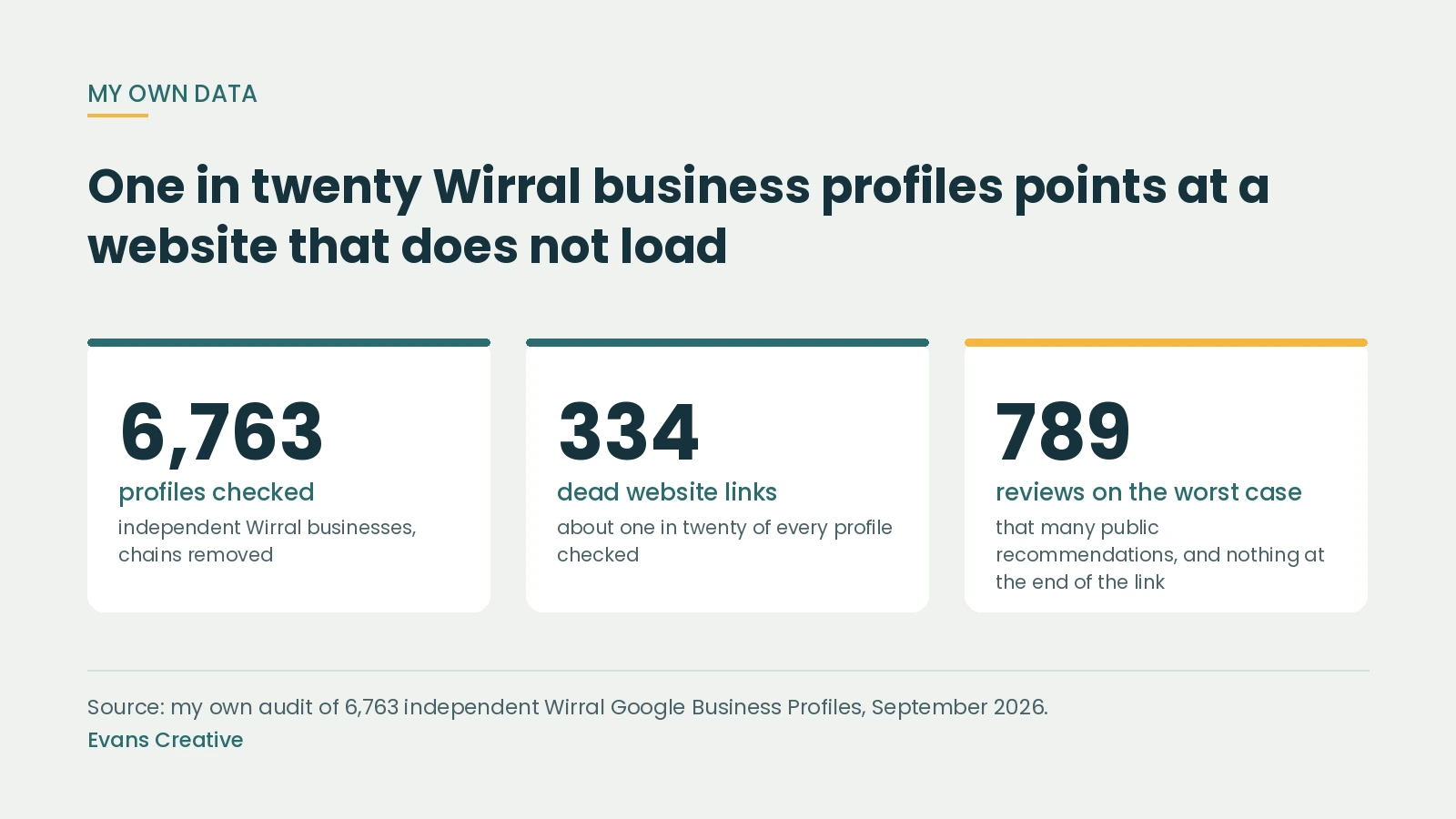
- One in twenty Wirral businesses sends customers to a website that does not load. I checked 6,763 profiles to find that. One of those businesses had 789 reviews.
- Coca-Cola spent 5.4 billion dollars on advertising in 2025, roughly four billion pounds. The most established names in the world are spending more on being remembered, not less.
- Brands that stop advertising do not hold steady. The best study on it found sales fell by roughly 16 per cent after a year of silence.
- The answer for a small business is not a campaign. It is making sure the recommendation lands somewhere that works.
Word of Mouth Really Is the Most Trusted Channel
Let me concede the strongest version of the argument first, because it is a good argument.
Nielsen’s Global Trust in Advertising study, which is the most quoted piece of research in this entire area, found that 83 per cent of respondents completely or somewhat trusted recommendations from friends and family. That was the highest score of any channel measured, ahead of branded websites on 70 per cent and online consumer opinions on 66 per cent, with paid formats well below both. The study dates from 2015, so I would not lean on the decimal places, and nothing published since has convincingly contradicted the ranking.
So when somebody tells me that a recommendation from a neighbour is worth more than anything I could build for them, they are right. I would rather have one of those than a month of rankings, and I say so.
The problem is not the quality of a referral. It is the supply.
Referrals Are a Ceiling, Not an Engine
Here is the awkward arithmetic.
Word of mouth is generated by people who have already bought from you. The number of recommendations you receive is therefore a function of how many customers you have, how often they talk, and how many people they talk to. Every one of those is either fixed or slow to change.
That produces a business which grows at whatever rate its existing base happens to refer, minus whatever it loses. And it always loses some. Customers move house, retire, close down, have a change of circumstances, or get taken by somebody who turned up at the right moment. None of that is a failure of service. It is just attrition, and it runs quietly in the background whether or not anyone is counting it.
A business running on referrals alone is therefore in a race between two numbers it does not control. When referrals exceed attrition, it grows, slowly. When attrition exceeds referrals, it shrinks, slowly, and it usually takes a year or two before anybody notices that the diary is not filling the way it used to.
The businesses that ring me are almost always in the second phase. Nothing has gone wrong. That is the most common thing they say, and it is what makes it difficult. Nothing went wrong. The phone just went quieter, and nobody can point at the week it started.
The Recommendation Does Not End the Search, It Starts One
This is the part that has changed most in the last fifteen years, and it is the part most people underestimate.
When somebody recommends you, that is not the end of the process. It is a shortlisting event. The person who received the recommendation now does what everybody does, which is look you up.
BrightLocal’s 2026 Local Consumer Review Survey found that 97 per cent of consumers read reviews when choosing a local business, that 68 per cent will only consider a business rated at four stars or above, and that 31 per cent hold out for four and a half. Recency mattered too: 74 per cent wanted to see reviews written in the last three months. Strikingly, 49 per cent said they trust online reviews as much as a personal recommendation from someone they know.
Their separate 2026 research on search behaviour, covering 1,227 consumers who had looked for a local business in the previous three months, found that 52 per cent started on Google Search and that 75 per cent used more than one channel before deciding. Both samples are American, so treat the exact figures as directional for a UK audience rather than gospel. Nothing I have seen in UK client data suggests the behaviour is meaningfully different.
Read those numbers together and the implication is uncomfortable. The recommendation gets you looked up. What happens during the looking up decides whether you get the call, and you have no idea it is happening. There is no notification when somebody searches your name, finds a Facebook page last updated in 2021 and a Google listing with two reviews, and quietly rings the other name their friend mentioned.
What That Gap Looks Like on the Wirral
I have measured this locally rather than taken it on faith.
In September 2026 I checked the Google Business Profiles of 6,763 independent Wirral businesses, chains removed, and followed every website link on them. 334 of those profiles, about one in twenty, sent customers to a website that did not load at all. Counted against the websites rather than the profiles, it was closer to one in twelve. Roughly half of the dead links pointed at domains that no longer existed, a third at domains that were live but erroring, down or hacked, and the rest at website builder plans that had lapsed.
The detail that matters for this argument is who those businesses were. At least 33 of them had 50 or more Google reviews. The highest had 789. That is a business with 789 people who thought enough of the work to write it down in public, and every one of those people who tapped through from the profile arrived at nothing.
There is a second finding worth putting next to it. The median business with a working website had 27 reviews. The median business with a broken one had 8. I am not going to claim the dead link caused that difference, because the causation could plausibly run either way and probably runs both. What I will say is that it is consistent with the rest of this argument. The businesses that are hardest to reach are also the ones accumulating the least public proof, and the two problems feed each other quietly for years.
Every one of those 334 profiles is a recommendation arriving at a dead end. Source: my own audit of 6,763 independent Wirral Google Business Profiles, September 2026.
What the Biggest Brands in the World Still Spend
Now to the part of this argument that I find genuinely settles the question.
If awareness were a job that could be finished, there is one company on earth that would have finished it. Coca-Cola has spent more than a century building recognition, sells in practically every country there is, and has a logo that people can identify from a fragment of the colour. By any reasonable definition, everyone already knows who they are.
In 2025, Coca-Cola spent 5.4 billion dollars on advertising, which is roughly four billion pounds at this year’s exchange rates. That is not a figure from a marketing blog. It is disclosed in their own annual report on Form 10-K, filed with the US Securities and Exchange Commission, and it went up from 5.1 billion the year before.
They are not alone, and the pattern is the same everywhere you look.
| Company | Disclosed Spend | Financial Year | Share of Revenue |
|---|
| Coca-Cola | 5.4bn dollars, advertising | 2025 | About 11% of 47.9bn dollars |
| Procter and Gamble | 10.2bn dollars, advertising | To 30 June 2026 | About 12% of 87.0bn dollars |
| Unilever | 8.1bn euros, brand and marketing investment | 2025 | 16.1% of 50.5bn euros |
| Amazon | 23.5bn dollars, advertising | 2025 | About 3% of 716.9bn dollars |
| Apple | Not separately disclosed | 2025 | Reports 27.6bn dollars of selling, general and administrative costs |
A Note on Apple, Because Everybody Asks
Apple is the name people reach for, and the figures floating around online are mostly invented. Apple has not disclosed an advertising expense separately since its 2015 financial year, when it reported 1.8 billion dollars. Everything published since is an estimate, and I am not going to present an estimate as a fact when the rest of this table comes from audited filings. What Apple does disclose is 27.6 billion dollars of selling, general and administrative expenses in the year to September 2025, which includes advertising among a good deal else. The honest summary is that Apple spends a great deal and declines to tell us how much.
The point of the table is not the size of the numbers, which are meaningless at the scale of a business in Birkenhead. It is the share of revenue, and it is the direction of travel. Unilever has increased brand and marketing investment by three percentage points of turnover over four years. Procter and Gamble went from 8.0 billion dollars in 2023 to 10.2 billion in 2026. These are the most established consumer brands in existence, with nothing left to prove about who they are, and they treat marketing as a permanent operating cost on the scale of a tenth of everything they earn.
Nobody at Coca-Cola thinks the job of being known is finished. It is worth asking why a local business would conclude that its own version of that job is.
Being Known Decays
The reason those companies keep paying is that awareness leaks.
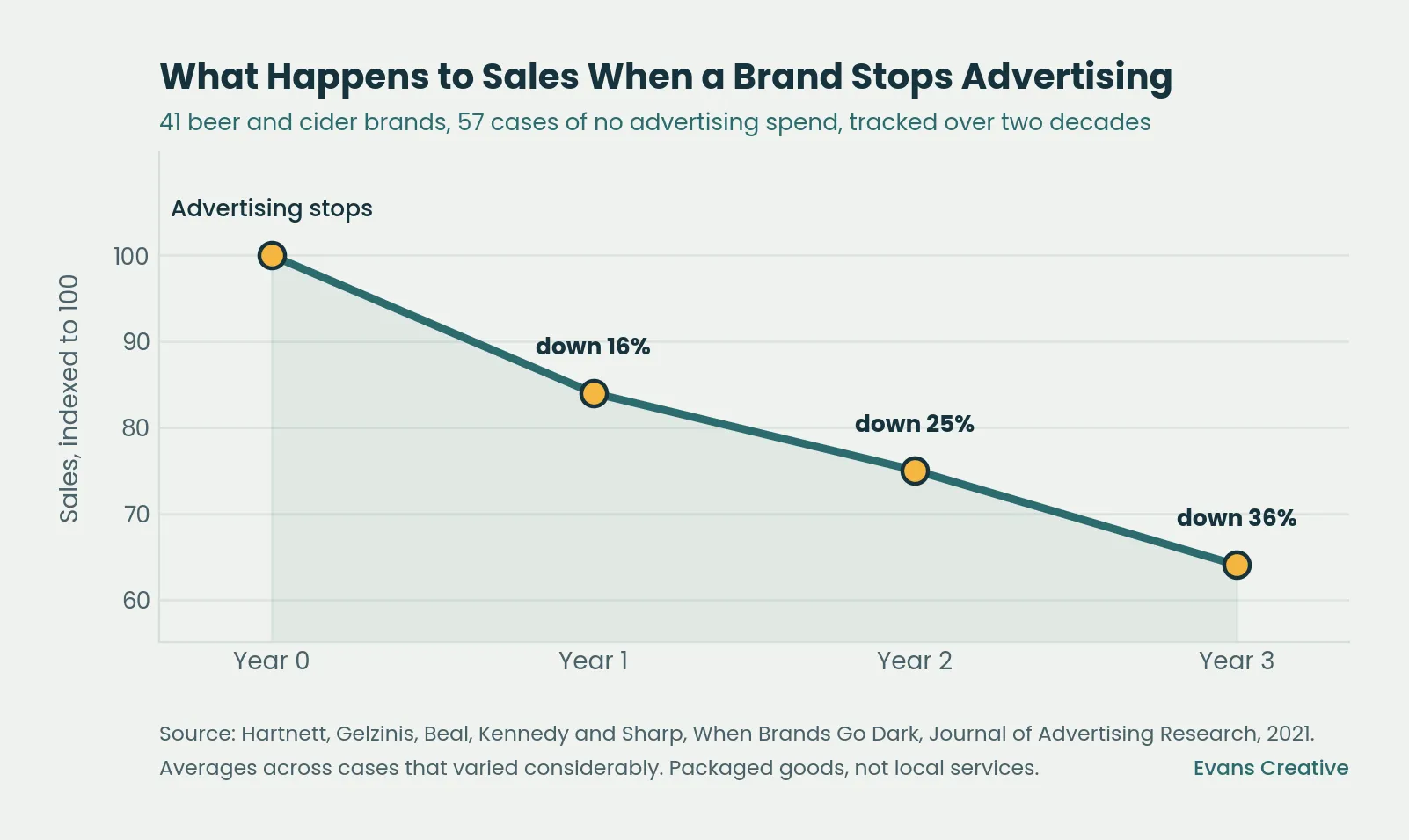
The best evidence on this is a study published in the Journal of Advertising Research in 2021, which examined 41 beer and cider brands over two decades and identified 57 cases where a brand stopped advertising entirely. The brands that went dark did not hold their position. On average, sales fell by around 16 per cent after one year without advertising, 25 per cent after two years and 36 per cent after three.
Two caveats, because they matter. That is packaged goods, sold through supermarkets, in a category with heavy competitive pressure, and a local service business does not work like a beer brand. The decline is also an average across cases that varied a lot. What survives the caveats is the shape of it: stopping did not produce a plateau. It produced a slope, and the slope got steeper the longer the silence went on.
Stopping did not produce a plateau, it produced a slope. Beer and cider brands rather than local services, so read the shape rather than the exact figures.
That is what is happening to a business relying on word of mouth alone, only slower and more politely. The customers who knew you get older and move on. The people who would have recommended you forget to. The new arrivals in the area have never heard the name at all, because the only place your reputation lives is inside the heads of people who already know you.
The Objection I Actually Agree With
I want to be fair to the strongest counter-argument, because there is one and I have used it myself.
If you are at capacity, booked six weeks out, and have no wish to grow, then spending money to create demand you cannot serve is genuinely a bad idea. A one man trade with a full diary does not need a marketing budget. It needs a price increase, which is a different conversation and usually a better one.
The risk in that position is not the ordinary week. It is the unusual one. It is the largest customer who accounts for a third of turnover and gets bought out. It is the contract that ends. It is the competitor who arrives with a real marketing budget and starts taking the enquiries you never knew existed because you never saw them. A business with no way to generate demand other than waiting has no answer to any of that, and by the time it needs an answer it is trying to build one from a standing start while the money is running out.
Which is why the honest version of my advice to a busy business is not to buy a campaign. It is to build the thing that catches demand before you need it, while there is no pressure on it to work by Friday. I have written about that timing problem in more detail in how to get more enquiries, and the short version is that the best moment to start is the moment it feels least urgent.
What This Looks Like for an Actual Small Business
None of this is an argument for a small firm to imitate Unilever’s ratio. Sixteen per cent of turnover on marketing would be ruinous for most local businesses, and I am not suggesting it. Applying a big brand percentage arithmetically to a small business budget is a good way to waste a lot of money quickly.
The transferable principle is narrower and cheaper than that. Being findable is a recurring cost, not a project you complete once. And the first job is not reaching strangers. It is making sure the people who already have your name can finish the journey somebody else started for them.
The Ten Minute Check
Before you spend anything, find out what those people see. Take a phone you are not signed in to Google on, search your business name and your town, and check six things.
- Something of yours comes first. If Yell, Checkatrade or a dormant Facebook page outranks your own site for your own business name, your recommendations are being delivered to somebody else’s advertising.
- The Google Business Profile is claimed and correct. Opening hours, phone number, address, and a primary category that matches what you actually do.
- The website link works. Tap it, do not just look at it. One in twenty Wirral businesses fails at precisely this step, and a customer who hits a dead link almost never rings to mention it.
- The newest review has a date you are not embarrassed by. Three quarters of people want to see something written in the last three months. A five star average whose most recent entry is from 2022 reads as a business that may have closed. What reviews do and do not do for your rankings is covered in do Google reviews help SEO.
- The photographs are of your work. Not stock images, and not the building in 2017 with a different sign above the door.
- The site answers the first question a customer asks. Areas covered, an honest indication of price, how quickly you respond, and what happens if something goes wrong. Most local websites answer none of these, which is why so many of them convert badly.
That takes ten minutes and costs nothing. Anything that fails it is losing you referrals you have already earned, from people you will never hear from and cannot count, which is exactly why it goes unfixed for years.
Only once that is solid does spending money on strangers make sense. That is where local SEO starts to earn its keep, and for the Wirral specifically I have written about how to show up for near me searches. The order matters more than the budget. Fixing the leak is always cheaper than increasing the flow, and it is the part nobody tries to sell you.
The Bottom Line
Word of mouth is not the alternative to marketing. It is the outcome of marketing that worked, and it behaves like any other asset: it depreciates if nothing is put back in. The most recognisable brands in the world understand that better than anyone, which is why they keep spending long after there is nobody left to introduce themselves to. Coca-Cola is not advertising to tell you that Coca-Cola exists. It is advertising because being remembered is a subscription rather than a purchase.
A small business needs none of that scale. It needs the recommendation it has already earned to land somewhere that works, and it needs to be findable by the people who have not heard the recommendation yet. If all your work comes from word of mouth, that is a compliment to the work. Just do not mistake a compliment for a strategy.
Not Sure What People See When They Look You Up?
The ten minute check above finds the obvious problems. A local SEO audit finds the rest: what your profile is missing, where competitors are appearing and you are not, and which of it is worth fixing first rather than eventually.
If the answer turns out to be that your setup is fine and the quiet phone is coming from somewhere else, I will tell you that instead.
Local SEO Audit